Quick Answer
Most Indian toddlers are ready for daycare between 18 months and 2.5 years, once they can manage short separations and show interest in other children. A good daycare centre offers low staff ratios, clean routines, and learning through play. Fees commonly range from ₹5,000 to ₹20,000 a month depending on city and hours.
- Readiness depends more on a child’s temperament than on a birthday.
- Fees change with the city, hours of care, and what the fee actually includes.
- A good daycare day balances structure, free play, meals, and rest.
- Staff to child ratio is one of the clearest quality signals.
- One unhurried visit tells parents more than any brochure.
Introduction
Many parents wonder if their toddler is ready for daycare, and whether anyone outside the family can be trusted with those small, precious hours. Both questions are fair, and neither has a one line answer.
Here is what is worth knowing first. India’s National Education Policy 2020 notes that over 85% of a child’s brain development happens before the age of 6. Those early years are less like a waiting room and more like a garden in its first season: what gets planted, watered and protected now shows up for years.
This guide walks through age, cost, daily routine and safety, using the way Welmont approaches daycare: structured, play based and led by what each child actually needs.
What is a daycare centre, and how is it different from a creche, playschool and preschool?
A daycare centre looks after children for a full working day, usually nine to ten hours, and combines care, meals, rest and early learning. A creche is generally more basic and custodial. A playschool or preschool runs shorter sessions with a stronger focus on learning readiness.
In practice, the labels overlap a lot, which is why parents often feel confused. The simplest test is the length of the day and what fills it. A creche mainly keeps a child safe and fed. A preschool mainly prepares a child for formal schooling under the Foundational Stage described in NEP 2020. A good daycare does both: it covers the long working day and still builds language, movement and social confidence along the way.
Many families end up using both. A child may attend a morning learning programme and stay on for daycare through the afternoon.
Who is daycare for?
Daycare suits working parents without a daily caregiver at home, nuclear families where both adults are employed, and parents who want their toddler to spend time with other children. It is not only a matter of convenience. For an only child especially, regular peer company teaches turn taking, sharing and patience in a way that adults rarely can.
The typical reader in Jaipur, Lucknow, Noida or Agra is a working parent weighing three options: grandparents, a nanny, or a centre. Each can work well.
When is home care or a nanny the better choice?
Honest advice matters here. Grandparent care is warm, familiar and often the best fit for a child under 18 months, particularly one who is easily unsettled by new places. A nanny can be right for families who need very flexible hours or who have a child with specific needs that suit one to one attention.
Daycare tends to win when a family wants a predictable routine, trained staff, learning built into the day, and a backup plan that does not collapse when one person falls ill. Many families land on a mix: a few days at the centre and the rest at home with grandparents. Part time attendance is a perfectly reasonable way to begin.
Parents may also worry about grandparent input and mixed opinions at home. A good centre welcomes that conversation. Inviting grandparents to a visit often settles doubts faster than any explanation.
What is the right age to start daycare in India?
Most centres in India accept children from around 6 months, but 18 months to 2.5 years is the age band where structured toddler programmes tend to work best. By then, many children can handle a few hours away from a primary caregiver, follow simple routines and enjoy being around other children.
Age is only part of the picture. Sleep stability, comfort with short separations and emotional bonding matter just as much. A 14 month old with a calm routine may settle more easily than a 2 year old who has never spent an hour away from home.
| Age band | What it usually suits | Readiness signs |
| 6 to 18 months | Infant care, parents returning to work | Settled feeding and sleep pattern, comfort with a few trusted caregivers |
| 18 months to 2.5 years | Toddler daycare, playgroup transition | Curiosity about new spaces, short separations without extreme distress |
| 2.5 to 4 years | Nursery and structured play | Follows simple instructions, shows interest in peers |
A paediatrician or child development specialist is the right person to speak to if a particular worry about development is weighing on the decision.
What does a good daycare day look like?
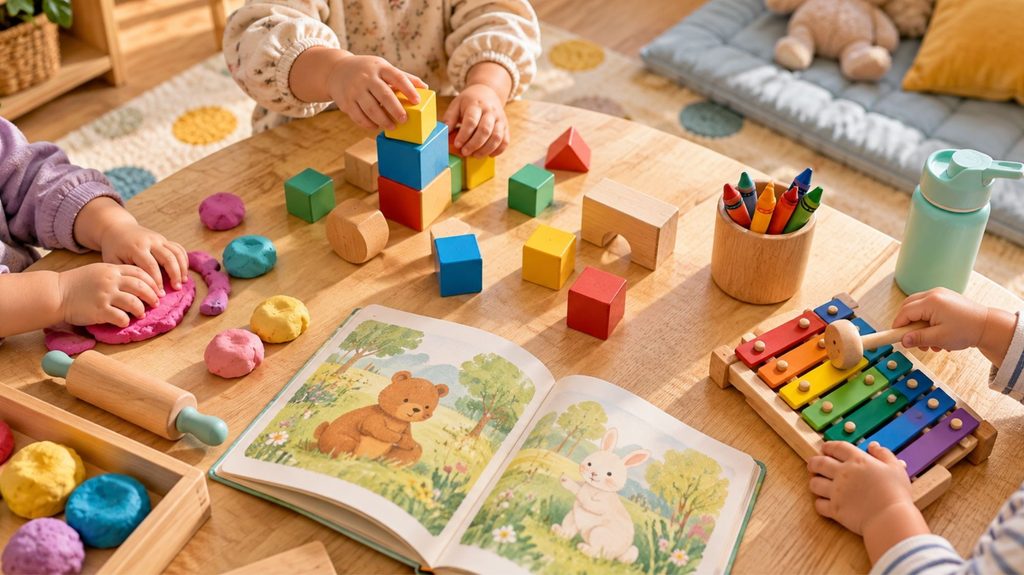
A good toddler daycare day moves gently between active and quiet, group time and free time. Expect arrival and settling, circle time, a snack, play, lunch, a proper nap, outdoor time and a calm handover. Children this age thrive on rhythm, so predictability is a sign of quality, not rigidity.
Here is a sample day for a 2 to 3 year old:
- Arrival and settling: a health check, a warm greeting and free play while everyone arrives.
- Circle time: rhymes, stories and simple talk about the day ahead.
- Morning snack: a short, calm break, often with practice at self feeding.
- Play and activity: sensory play, movement, music or early language games.
- Lunch: a balanced meal followed by a wash up routine.
- Nap or quiet rest: a clean, comfortable space and a consistent wind down.
- Outdoor play: fresh air, running, climbing and plenty of space to move.
- Afternoon snack and creative time: art, free play and a gentle goodbye routine.
- Pick up: a short update to parents on how the day went.
At Welmont, named activity blocks fit into this rhythm: Dance WigglyWay for movement, MusicWelTunes for rhythm and listening, LinguisticsWordWay for phonics and early language, WellnessWellWay for healthy habits, and the Once Upon A Time storytelling circle.
For a closer look, read a day in the life at Welmont.
How much does daycare cost in India?
Daycare fees in India vary widely, with many parents seeing monthly figures somewhere between ₹5,000 and ₹20,000. There is no fixed government ceiling. City, hours of care, staff ratios, meals and the quality of the building all shape the final number.
Here is what usually moves the price:
- City and neighbourhood: rent is a big part of a centre’s costs, so premium metro areas cost more than smaller cities.
- Hours of care: a full nine to ten hour day needs more staff, meals and space than a three hour session.
- Safety and staffing standards: CCTV, trained educators, sensible ratios and transport add real cost.
- Reputation and curriculum: centres that invest in trained staff and a tested programme generally charge more.
The fee alone says very little. Two centres at the same price can offer very different things, so ask what is actually included: meals, nappies, extended hours, activities, transport, and any one time registration fee. Part time plans are often priced at roughly half of a full month, not a fixed daily rate, because the centre’s fixed costs do not shrink when a child attends fewer days.
What should parents check for safety, hygiene and staffing?
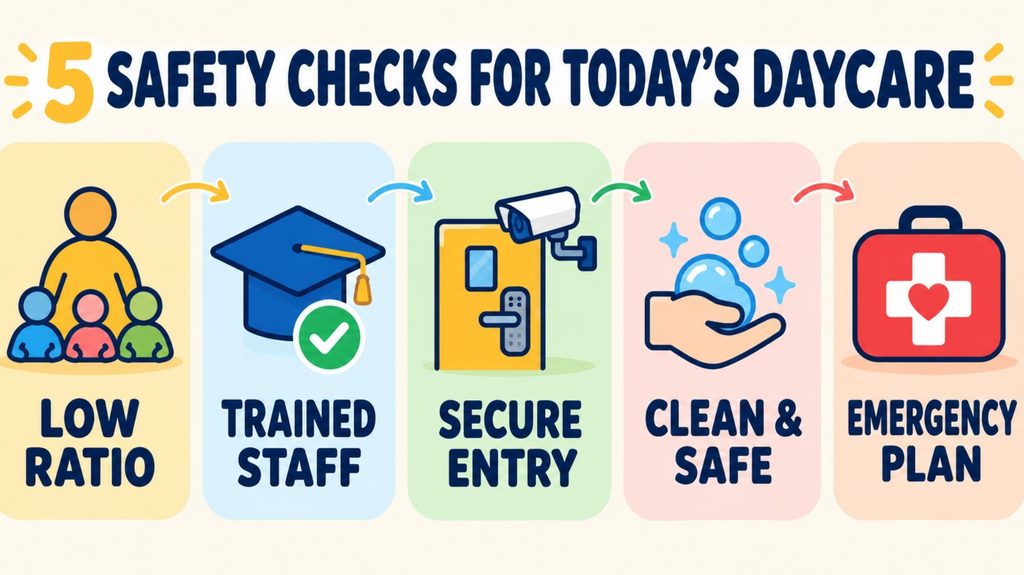
A trustworthy daycare has a low staff to child ratio, trained and screened staff, controlled entry with CCTV, visible hygiene routines and a clear emergency plan. For infants, a ratio around 1 adult to 3 children is widely seen as ideal. For toddlers, 1 to 5 or 1 to 6 is a common benchmark.
The World Health Organization, UNICEF and partners describe safety and security as one of five components of nurturing care, alongside health, nutrition, responsive caregiving and early learning (Nurturing Care Framework, WHO, UNICEF and World Bank Group, 2018). That framing is a useful one for parents: safety is part of how a child learns, not separate from it.
Five things worth checking in person:
- Ratios: ask how many adults are with a group of toddlers at any given time, including during nap and meals.
- Staff screening and training: ask about background checks, early childhood training, first aid and child protection policies.
- Entry and monitoring: look for controlled access, visitor logs and whether parents can view CCTV.
- Hygiene routines: watch for sanitised toys and surfaces, separate changing areas, handwashing for children and staff, and clean bedding.
- Emergency plan: ask what happens if a child falls ill, has an accident or needs medication, and who is trained to respond.
Trust instincts too. Disengaged or impatient staff, unsupervised children, high staff turnover and vague answers about emergencies are all worth taking seriously. For a deeper list of questions, read daycare safety and hygiene questions parents should ask.
What should parents expect in the first two weeks?
Most toddlers take one to two weeks to settle into daycare. Clinginess, tears at drop off and a slightly disrupted sleep pattern are common in that window, and they do not mean the choice was wrong. Consistent caregivers and clear communication usually make the biggest difference.
Think of the first morning at the school gate. A toddler may cling, a parent may linger, and both walk away wondering if it was a mistake. By the second week, that same child often waves from the door and runs to a favourite corner. Separation anxiety is a normal stage of development, not a failure of parenting or of the centre.
What tends to help:
- A gradual start, with shorter days in the first week where the centre allows it.
- A short, calm goodbye. Long, anxious farewells make things harder, not easier.
- A familiar comfort item from home, such as a small blanket or soft toy.
- A daily check in with the caregiver about meals, sleep and mood.
- A home routine that stays steady in the evenings.
Parents who see no improvement after a few weeks, or who notice persistent distress, should speak to the centre and, if needed, a paediatrician.
How does learning happen inside a daycare?
In a good daycare, learning is not a separate lesson. It happens through play, music, stories and movement, which is how toddlers actually build language, coordination and social skills. The goal is confidence and foundational skills, not early worksheets.
India’s Foundational Stage, as set out in NEP 2020 and NCERT’s curriculum framework for early years, puts play and activity at the centre of learning for young children. Welmont follows the same spirit through its own philosophy: the child’s Happiness Quotient, observation based learning, and the Metamorphosis approach, which looks at both the child’s developing brain and the environment around them.
Here is how the named activity blocks connect to real skills:
- Dance WigglyWay: movement and dance build balance, coordination and the large muscle control that later supports writing.
- MusicWelTunes: songs and rhythm sharpen listening, memory and early speech.
- LinguisticsWordWay: phonics, which means learning the sounds that make up words, lays the groundwork for reading.
- WellnessWellWay: simple routines around hygiene, food and rest build healthy habits.
- Once Upon A Time storytelling circle: stories grow vocabulary, imagination and the habit of sitting together and listening.
Indian sanskars, such as respect for elders, gratitude and sharing, are woven into daily activity rather than taught as a lesson.
Once a month, teachers at Welmont meet in a Virtuous Circle to review each child’s development individually, based on what they have observed in class.
Parents who want ideas to try at home can browse the best preschool activities guide. Those thinking ahead to the next stage may also like how to prepare a toddler for preschool.
What is a 10 point checklist for visiting a daycare?
A good visit is calm, unhurried and a little nosy. Parents should see the rooms, watch the staff and ask questions. Screenshot this list and take it along.
- Location and hours: is it close to home or work, and do timings match a real working day?
- Safety measures: controlled entry, CCTV and a clear emergency plan.
- Staff qualifications: trained educators with real early childhood experience.
- Adult to child ratio: lower means more personal attention, around 1 to 3 for infants.
- Hygiene: sanitised toys, clean bedding, separate changing areas and handwashing stations.
- Meals: balanced, nutritious food prepared with care and clear allergy handling.
- Daily routine: a steady rhythm of play, meals, nap and outdoor time.
- Curriculum: play based, Montessori or activity led, with a clear explanation of how it supports development.
- Cost and inclusions: what the fee covers, and what is extra.
- Parent communication: how updates are shared, and whether parents can observe or visit.
Useful questions to ask on the day: Are you licensed and accredited? How do you track vaccinations? What happens when a child is unwell? Can I observe my child’s day?
Where can parents find Welmont daycare near them?
Welmont runs centres across Jaipur, Lucknow, Noida and Agra, each following the same philosophy with local timings and teams. Parents can visit the main daycare page for programme details, or explore the programmes available at each age.
Jaipur centres:
Other cities:
Conclusion
Choosing a daycare is not about finding a perfect place. It is about finding a place that is safe, steady and warm, where a toddler can grow at their own pace. Start with readiness, check the fee against what it includes, look hard at safety and staffing, and give the first two weeks time.
The best next step is simple: visit, watch and ask. Parents who would like to see how Welmont works in person can book a centre visit or send an admission enquiry, and see how a toddler’s day actually feels.