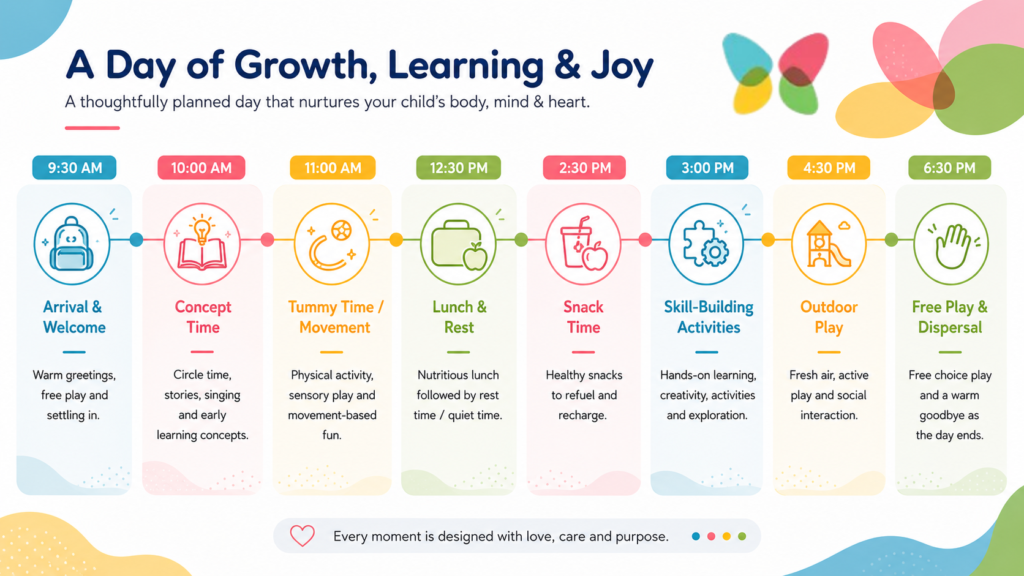
Quick Answer: A typical day at Welmont Preschool in Jaipur runs from morning arrival through structured concept time, movement and music activities, outdoor play, meals, rest, and gentle skill-building, ending with evening dispersal for daycare children. Every hour is designed around how young children actually learn best.
- Arrival and settling: 9:30–10:00 AM
- Concept and activity time: 10:30 AM–12:15 PM
- Play Group dispersal: 12:30 PM
- Lunch, rest, and snack: 1:15–3:30 PM
- Daycare activities and dispersal: 4:30–6:30 PM
Introduction
There’s a particular kind of quiet that settles over a parent standing in a car park at 9:45 in the morning, watching a small backpack disappear through a colourful gate. The child is fine, probably already forgotten the goodbye by the second hallway. The parent, meanwhile, spends the next few hours running a low hum of questions in the background of an otherwise ordinary day. Is she eating properly? Did he cry after I left? What are they actually doing in there for nine hours?
It’s a fair question, and a surprisingly rare one to get a straight answer to. Most preschool websites talk in big, soft words, nurturing, holistic, joyful, without ever showing what actually fills the hours between drop-off and pickup.
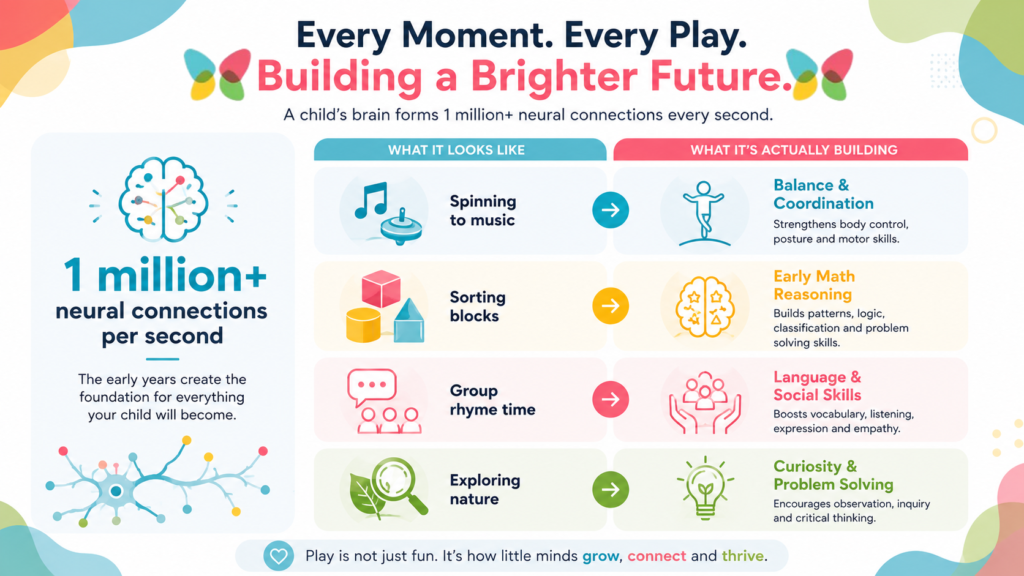
Here’s a fact worth holding onto while reading the rest of this: in these early years, more than one million new neural connections form in a child’s brain every single second, a pace of growth that will never happen again in their life. That’s not a reason to feel pressure. It’s simply why what fills those hours matters as much as it does. This is a real, hour-by-hour walk through a day at Welmont Preschool in Jaipur, not a brochure description of one.
What Does a Typical Day at Welmont Actually Look Like?
A day at Welmont runs from roughly 9:30 AM to 6:30 PM, structured around a steady rhythm of concept-based learning, movement, rest, and free play, not a single unbroken block of lessons. This rhythm is consistent across Welmont’s campuses, including Mansarovar and Vaishali Nagar, so the day looks and feels the same no matter which centre a family chooses.
| Time | Activity |
| 9:30 AM | Arrival |
| 10:00 AM | Assembly and settling time |
| 10:30 AM | Concept Time 1 |
| 10:45 AM | Tummy Time |
| 11:15 AM | Activity Time – Dance, Music, STEM, Yoga, or Storytelling |
| 11:45 AM | Concept Time 2 |
| 12:15 PM | Indoor and outdoor play-based activities |
| 12:30 PM | Dispersal for Play Group children |
| 1:15 PM | Change of clothes and lunch |
| 3:00 PM | Sleep time and freshen up |
| 3:30 PM | Snack break |
| 4:30 PM | Homework help and activity-based learning (phonics, handwriting, etc.) |
| 5:30 PM | Outdoor activities including games and sports |
| 5:45 PM | Fruit time |
| 6:15 PM | Indoor activities such as art and craft or free play |
| 6:30 PM | Dispersal for Daycare children |
Worth noticing before diving into each block: this isn’t a schedule built for convenience. Every shift, from stillness to movement, from group time to solo exploration, is placed exactly where a young child’s attention span naturally needs it to be.
Morning, Arrival, Settling In, and the First “Concept Time”
The first thirty minutes are rarely glamorous, and that’s by design. A child might arrive on a Monday holding tightly to a parent’s leg, and by Thursday, walk in waving over their shoulder without looking back. Both versions of that child are doing exactly what they’re supposed to.
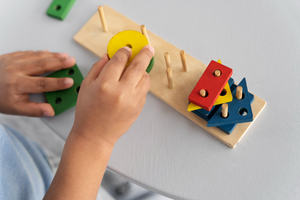
This settling window isn’t wasted time before the “real” learning starts. It’s the emotional groundwork everything else depends on, a child who feels safe enough to separate calmly is a child who’s actually available to learn for the rest of the day. Once assembly wraps up, Concept Time 1 begins around 10:30, and for a three-year-old, “concept” rarely means sitting still with a worksheet. It looks more like sorting colourful blocks by shape, counting fingers during a rhyme, or matching pictures during a group game, ideas absorbed through hands and play long before they’re absorbed through pencils.
Tummy Time and Movement, Why the Body Comes Before the Brain
By 10:45, the room shifts gears entirely. Tummy Time, followed by Activity Time at 11:15, dance, music, STEM exploration, yoga, or storytelling depending on the day, isn’t a break from learning. For a young child, movement is a form of learning.
A growing body of early-childhood research backs up something that feels almost obvious once it’s said out loud: the brain needs the body’s motion to build strong neural pathways, especially in these formative years. A child spinning to music or stretching through a simple yoga pose is doing quiet, serious developmental work, building coordination, balance, and the kind of physical confidence that later shows up as classroom focus.
Lunch, Rest, and the Quiet Hours Parents Never See
At 1:15, the room slows down for a change of clothes and lunch, and by 3:00 PM, it slows further into sleep and freshen-up time. This is often the part of the day parents picture least, no activity, no obvious “learning” happening. But for a young child, rest is not downtime tacked onto the schedule. It’s treated with the same seriousness as anything active, because a well-rested afternoon is what makes everything that follows actually land.
A snack break at 3:30 gently eases the room back awake, small hands reaching for fruit and milk before the afternoon stretch begins.
The Afternoon Stretch, Skill-Building and Free Play
From 4:30 onward, the day leans into more focused skill-building, phonics, early handwriting, and homework-style support for children in the older programs, delivered through activity rather than repetition drills. This is also where language work quietly deepens, phonics and vocabulary woven into games rather than flashcards.
By 5:30, it’s back outside for games and sports, fruit time follows at 5:45, and the day winds down gently with art, craft, or simply free play from 6:15 until dispersal for daycare children at 6:30. It’s a long day for a small person, but it never feels like one hour dragging into the next. It feels, quite deliberately, like several small days stitched together.
How Parents Stay Connected All Day
Parents don’t have to wait until pickup to know how the day is going, Welmont’s School Diary App keeps that thread of connection open in real time.
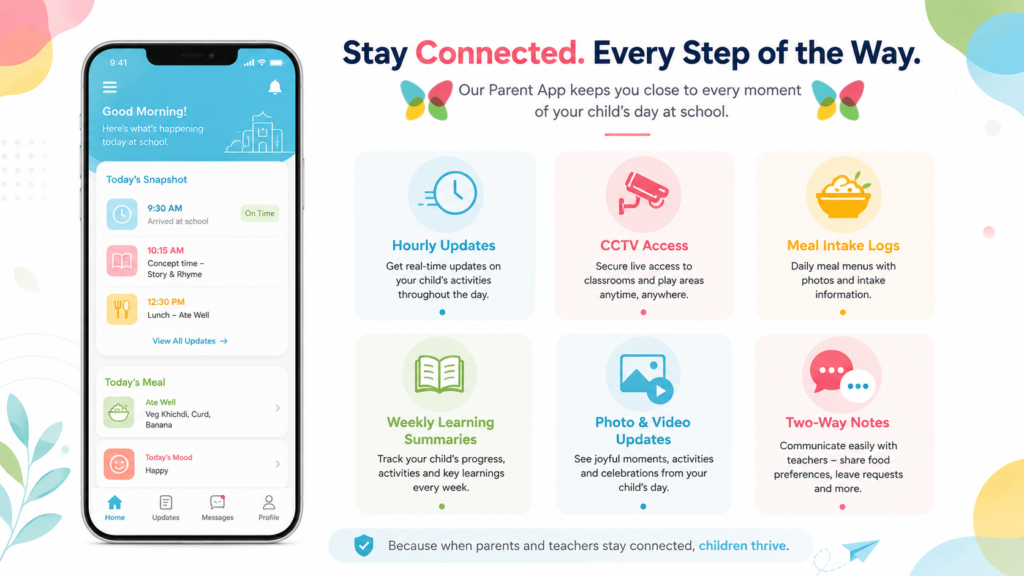
Through the app, parents get hourly updates as the day unfolds, along with CCTV access, meal-intake logs, weekly learning summaries, and photos and videos capturing the small, ordinary moments that make up a child’s day. It also works both ways, parents can flag food preferences, note a sniffle from the night before, or request leave, all without a single phone call. For a parent standing in that car park wondering what’s happening behind the gate, this is often the difference between quiet worry and quiet reassurance.
Where Play Meets Purpose: The Curriculum Behind the Schedule
None of this rhythm is accidental. Welmont’s approach draws from several respected early-childhood frameworks, including Finnish early education methods, Montessori principles, and multiple-intelligence theory, blended into a curriculum built around one central aim: not just teaching children facts, but teaching them how to learn in the first place.
As the American anthropologist Margaret Mead once put it, children must be taught how to think, not what to think. That idea sits quietly underneath every hour of this schedule, from the freedom of outdoor play to the focus of concept time, nothing here is asking a child to memorise. It’s asking them to explore, wonder, and build the thinking muscles they’ll rely on for the rest of their schooling.
Families can see how this rhythm shifts by age across Nursery, Junior KG, Senior KG, the Mother & Toddler programme, and Daycare.
The Day Behind the Gate
That low hum of parking-lot questions doesn’t have to stay unanswered. Those hours behind the colourful walls aren’t a mystery, they’re a carefully built rhythm of movement, focus, rest, and connection, each placed exactly where a young child needs it most.
Reading about a schedule is one thing. Watching it happen is another entirely. Parents curious about the real texture of a day at Welmont are always welcome to visit and sit in on a morning, no appointment small talk required, just an open door and an honest look inside.
Curious to see this schedule come alive? Explore Welmont’s programmes or plan a visit to watch a morning unfold in person.
Frequently Asked Questions
1. What time does a typical day start and end at Welmont Preschool?
The day runs from 9:30 AM arrival through 6:30 PM daycare dispersal, with Play Group children typically finishing at 12:30 PM.
2. How do parents stay updated during the school day?
Welmont’s School Diary App provides real-time hourly updates, CCTV access, meal-intake logs, weekly learning summaries, and photos and videos throughout the day.
3. Does Welmont include rest time during the day?
Yes, sleep and freshen-up time is built into the early afternoon schedule, treated as an essential part of a child’s day rather than downtime.
4. What kind of activities happen outside regular lessons?
Movement-based sessions like dance and music, outdoor play, storytelling, and art and craft are woven throughout the day alongside structured concept-learning blocks.
5. Can parents visit and see a school day in person?
Yes, families are welcome to schedule a visit and observe a morning directly before making an admission decision.