
Quick Answer
Separation anxiety at drop-off is common between ages 2 and 4, and it usually eases within a few weeks. A calm, consistent goodbye routine, trusted teachers, and a predictable pick-up time help most children settle. It is not a sign that something is wrong, with the child or with the choice of school.
- Common between ages 2 and 4, rarely a lasting problem
- A short, calm goodbye works better than a long one
- Consistency in caregiver and routine matters more than reassurance
- Grandparents and nannies can be part of the solution, with the right approach
- Most children settle within a few weeks
Introduction

Many parents wonder if their child’s tears at drop-off mean the school is wrong, or that something is wrong with their child. Neither is usually true. Separation anxiety at this age is a well documented, normal part of development, tied to a child’s growing attachment to their main caregivers meeting a brand new place and routine for the first time.
Welmont’s settling-in approach leans on close, patient observation rather than a fixed script, built around what each child actually needs in those first difficult mornings.
What does separation anxiety look like?
Separation anxiety usually shows up as crying or clinging at drop-off, but it can also appear as tummy-ache complaints, reluctance to get ready in the morning, or clingier behaviour at home in the evening.
A few common signs parents notice:
- Crying, clinging or refusing to let go at the door
- Complaints of a tummy ache or feeling unwell, with no other symptoms
- Dragging feet or resisting the morning routine
- Being extra clingy with a parent in the evening, even though the day at school went fine
None of these on their own are cause for alarm. They are the normal shape separation anxiety takes at this age.
Why does it happen in 2 to 4 years?
At this age, a child is forming a strong attachment to their main caregivers while also encountering a brand new place, routine and set of faces, and the two pull against each other.
This is sometimes called the push and pull of early attachment: a toddler needs to feel safely tied to a parent before they can confidently explore the world without them. Starting daycare or preschool asks a child to do exactly that, often before they are fully ready for it, which is why even a confident, easygoing child can struggle at first.
The Indian family factor
Many Indian families involve grandparents, nannies and more than one adult in daily care, which can actually help settling in, as long as one simple rule is followed: one person does the goodbye, not several.
Grandparent guilt is real and common. A grandparent who has been a child’s primary companion may feel the drop-off keenly, sometimes more than the child does. The advice that helps most is simple but not always easy to follow: pick one adult to handle drop-off consistently for the first few weeks, keep the goodbye short, and resist the urge to linger out of worry.
A short script that works for a grandparent at the door: a warm hug, a simple sentence like “I will be back after your snack,” and a prompt, cheerful goodbye. No explanations, no second goodbyes, no lingering by the gate. It feels abrupt at first. It is, in fact, kinder.
For more on getting a child ready for this transition, see preparing a toddler for preschool.
12 things that help
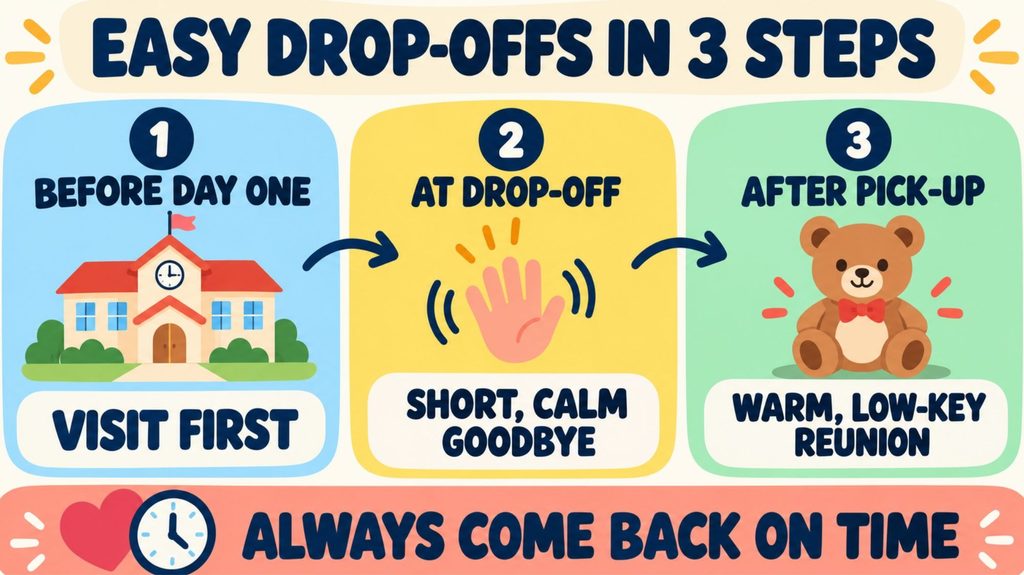
The twelve things below are grouped by timing, so a parent can jump straight to the stage they are in: before the first day, at drop-off, and after pick-up.
Before day one
- Visit the centre together beforehand, even briefly, so the space is not entirely new on the first real day.
- Start with short trial days if the centre allows it, building up to a full day over a week or two.
- Tell a simple story about “going to school,” what happens there, and that a parent always comes back.
- Build a consistent morning routine in the days leading up to the start, so the day itself feels familiar.
At drop-off
- Use a short, calm goodbye ritual, the same words and gestures each day.
- Hand the child directly to a teacher rather than leaving them to find their own way in.
- Never sneak out without saying goodbye, even if it seems easier in the moment.
- Keep the promised pick-up time, so trust in “coming back” builds steadily.
After pick-up
- Keep the reunion low-key and warm, rather than an anxious flood of questions.
- Ask open questions like “what did you play with today” rather than “were you okay.”
- Keep the evening calm and predictable, since a child may be more tired than usual.
- Let a comfort item, such as a small toy or blanket, travel with the child both ways if the centre allows it.
See a day in the life at Welmont for what the hours between drop-off and pick-up actually look like.
Mistakes that make it worse
A few well-meaning habits tend to extend separation anxiety rather than ease it:
- Lingering at drop-off. A long goodbye signals to the child that there is something to worry about.
- Sneaking out. It avoids the tears in the moment but tends to make the next day’s goodbye harder, since trust takes a hit.
- Reacting with visible worry. Children pick up on a parent’s anxiety quickly, even when nothing is said.
- Switching which adult does drop-off day to day. Consistency in both routine and person makes a bigger difference than most parents expect.
What Welmont teachers actually do
In the first days, Welmont teachers focus on close observation and welcoming body language, meeting each child where they are rather than pushing them into the group straight away.
Each child’s adjustment is supported by Welmont’s Virtuous Circle approach, which encourages reflective teaching and helps create a learning environment that supports children’s individual needs, happiness, and growth.
How long does separation anxiety last?
Most children settle within a few weeks, though the exact timeline varies by child, age and temperament. Some children take to the new routine within days; others need closer to a month of steady, consistent handling before the mornings feel easy.
There is no single number worth promising a parent. What matters more is whether things are trending in the right direction week over week, not whether a specific day has gone perfectly.
When should parents ask for help?
Most separation anxiety eases on its own, but persistent, severe distress, or changes in sleep, eating or physical symptoms that continue for weeks, are worth discussing with a paediatrician.
This is not about diagnosing anything. It is simply about knowing when a normal adjustment period has gone on longer, or harder, than usual, and bringing in someone qualified to look closer. A paediatrician or child development specialist is the right person to speak to if this stage feels unusually difficult or prolonged.
Looking after yourself

A parent’s own calm at drop-off is one of the strongest things that helps a child settle, so this stage is hard on parents too, and that is entirely normal.
It is common to feel guilt, worry, or even relief, sometimes all in the same morning. None of that makes a parent any less caring. Finding ten minutes after drop-off, even just a quiet walk to the car, helps many parents reset before starting their own day. The hard mornings do pass, for the parent as much as the child.
Conclusion
Separation anxiety at drop-off is common, it usually passes, and consistency matters more than any single trick. A short goodbye, a trusted routine, and patience through the first few weeks carry most families through this stage.
Parents who want to talk through settling-in support, or see how a centre handles the first days, are welcome to speak to the Welmont centre team.
Frequently Asked Questions
Yes, it is common in the early weeks, and it usually does not reflect anything being wrong at home or at the centre. If it continues unchanged for several weeks, it is worth mentioning to the centre or a paediatrician.
Most children settle within a few weeks, though this varies by child. Watching for steady improvement over time matters more than expecting a quick fix.
A brief settling-in visit beforehand can help, but lingering on the actual first day often makes the goodbye harder, not easier. A short, warm, confident goodbye tends to work best.
Yes, as long as one person consistently handles the goodbye rather than switching between caregivers day to day, and the goodbye itself stays short and calm.
If distress is severe, does not ease after several weeks, or comes with changes in sleep, eating or physical symptoms, it is worth speaking to a paediatrician.