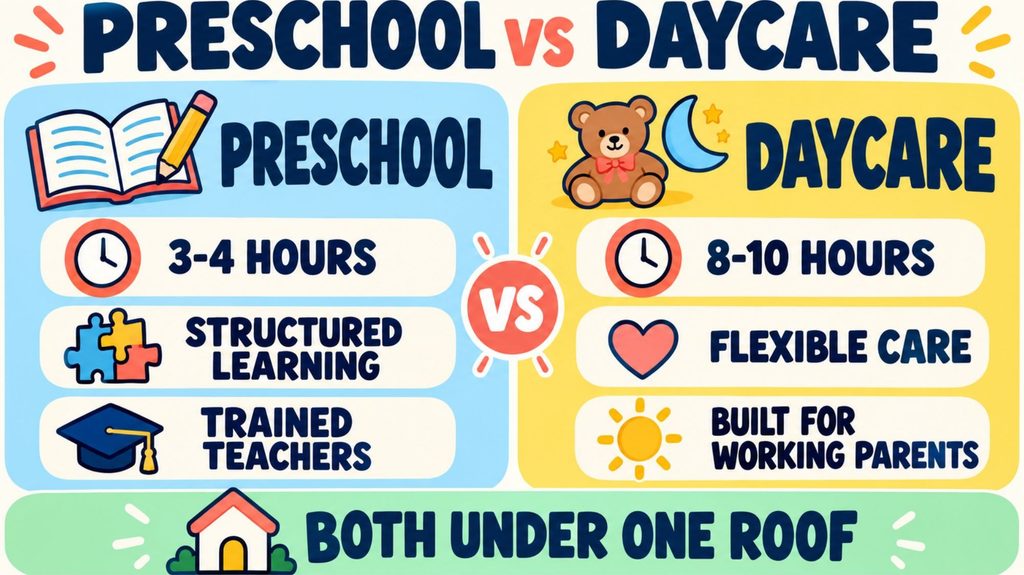
Quick answer: Preschool and daycare differ mainly in purpose and structure. Preschool focuses on a structured, curriculum led learning day, while daycare focuses on flexible, longer hours care. In India, the two words often overlap in practice, and many good centres, Welmont included, combine both under one roof.
- Preschool: shorter structured hours, curriculum led, teacher trained staff
- Daycare: longer flexible hours, care focused, built for working parents
- Many Indian centres blend both; the label matters less than the daily programme
- Choice depends on your child’s age and your family’s daily schedule, not which word “sounds better”
Introduction

Preschool, daycare, playschool, nursery. The words get used almost interchangeably, and it’s genuinely hard to tell what you’re actually signing up for. It helps to know that India’s own education framework doesn’t treat these as separate systems either. The National Education Policy 2020 and the National Curriculum Framework for the Foundational Stage cover children from age 3 to 8 as one continuous stage of play based early learning, rather than drawing a hard line between “daycare” and “preschool”. So take a breath. The label on the gate matters far less than what actually happens inside, hour by hour. Below, we’ll walk through a quick comparison, what the India specific words really mean, a look at a typical day in each, and how to decide, including a model that combines both.
Quick comparison table
| Factor | Preschool (typically) | Daycare (typically) |
| Purpose | Structured early learning, school readiness | Supervised care, often for working parents |
| Typical age | 2.5 to 6 years | 6 months to 6 years |
| Hours | Half day, 3 to 4 hours | Full day, often 8 to 10+ hours |
| Structure | Curriculum, circle time, planned activities | Flexible routine built around rest, meals, play |
| Staff training | Early childhood trained teachers | Mix of trained caregivers and support staff |
| Cost pattern | Often term based fees | Often monthly or hourly, usage based |
These are general patterns, not rules. Many centres blend the two, which is exactly where things get confusing, and exactly what the rest of this guide is here to untangle.
Preschool, playschool, nursery, creche: what do these words actually mean in India?
In India these terms overlap a lot and aren’t used consistently. “Playschool” and “preschool” are usually interchangeable, “nursery” often refers to a specific stage within a preschool’s curriculum, and “creche” usually means daycare style care for younger children. The safest approach is to ask a centre what a typical day actually looks like, not just what sign is on the door.
If you want the formal stage names spelled out (Playgroup, Nursery, Junior KG and how they line up with age and curriculum), our guide to Playgroup vs Nursery vs Junior KG breaks it down in detail. It’s also worth checking a centre’s Google Business Profile listing to see how it’s formally registered, since naming isn’t standardised across India the way it is in some other countries.
What does a typical day look like in each?
A preschool day is usually built around short, structured blocks: circle time, a learning activity, snack, outdoor play, all within three to four hours. A daycare day covers a longer stretch with more built in rest and flexible free play, designed to carry a child through a full working day.
Which suits your family: preschool, daycare, or both?
It depends less on your child’s age alone and more on your family’s daily schedule: how many hours you need covered, and whether your child is ready for structured group learning yet. Four situations below show how the decision usually plays out.
Working parents, an 18 month old. At this age, most children do better with daycare first care, plenty of comfort and routine, and gentle play based stimulation, rather than a full academic preschool day.
A first time preschooler, age 3. This is usually when a child is ready for a structured half day preschool programme. A daycare add on makes sense only if both parents work full days and need the extra hours covered.
A part time need, one working parent with flexible hours. A half day preschool slot alone is often enough here, without the extra cost or hours of full day care.
A dual income household needing full day coverage. This is where a combined preschool with daycare model earns its keep: structured learning hours plus extended care, without a second drop off and pickup at a different centre.
What is the hybrid model, preschool with daycare, and how does it work?
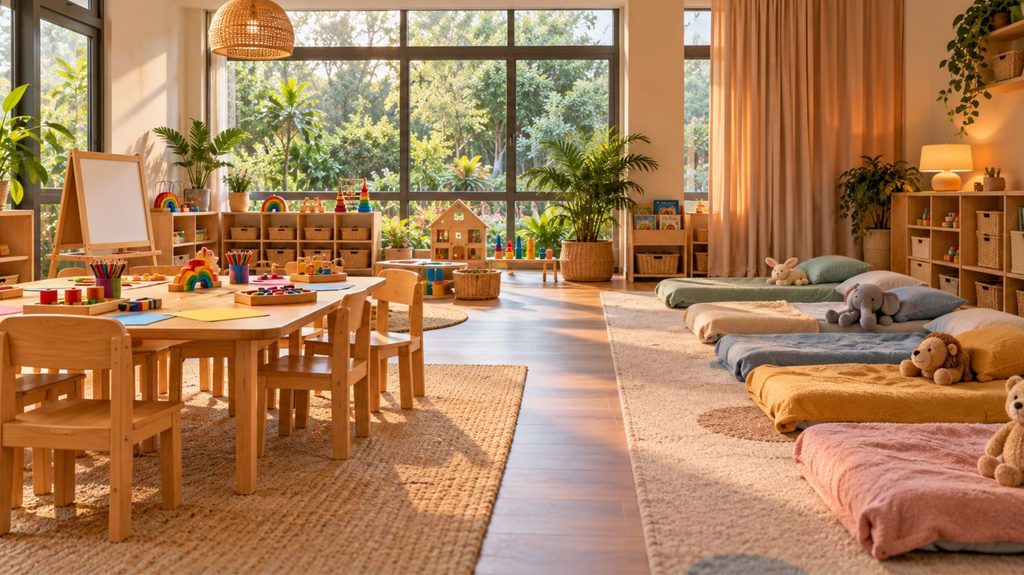
A preschool with a daycare model keeps a child in one place for the whole day: a structured curriculum in the morning, followed by supervised rest, play and extended care in the afternoon, instead of splitting a child’s day across two separate centres.
For working parents, this usually means one drop off, one pickup, and one consistent set of teachers and routines across the full day. [VERIFY WITH SCHOOL: how the handoff from curriculum hours to daycare hours actually works in a typical day, including whether it’s the same classroom and teachers or a separate wing.] If you’re weighing teaching philosophy as well as hours, our comparison of Montessori vs traditional preschool approaches can help you think through what kind of structure suits your child, alongside the practical question of hours. And if you’re in Jaipur, our Mansarovar centre page shows what this model looks like at one location specifically.
How does this connect to India’s Foundational Stage?
NEP 2020 and the Foundational Stage framework treat ages 3 to 8 as one continuous stage of early learning, folding what used to be separate “preschool” and “early primary” thinking into a single, play based approach. It’s one more reason the preschool or daycare label matters less than the actual daily programme a child experiences. If you’re still weighing when to start that journey at all, our guide on the right age to start preschool is a good next read.
What questions should I ask when I visit a preschool or daycare?
The questions that matter most are about the daily programme, not the label on the gate: ask about teacher to child ratios, how a typical hour is structured, how illness and safety are handled, and how the centre communicates a child’s progress.
- What does a typical day actually look like, hour by hour?
- What is the teacher to child ratio at my child’s age?
- How is my child’s progress observed and shared with me?
- What happens if my child falls sick during the day? (our daycare safety and hygiene FAQ covers what a well run centre should have in place)
- Is the daycare portion, if any, run by the same teachers or a separate team?
- What’s the policy on nap time, screen time, and outdoor play?
- How are transitions handled, both settling in and later moving up a stage?
- What does the fee structure actually cover: hours, meals, extended care?
Five things to compare before choosing
- Ask to see or walk through an actual daily schedule, not just a prospectus
- Confirm the teacher to child ratio for your child’s specific age group
- Check whether curriculum hours and extended care hours are run by the same teachers
- Ask how illness, hygiene and safety are handled day to day
- Match the hours offered to your family’s real daily schedule, not an ideal one
The takeaway
Preschool and daycare aren’t really two competing choices. They’re two different shapes of care, and most families end up needing a bit of both at some point. The label on the gate tells you less than an actual walk through of the day will. If you’re weighing a structured half day programme against longer flexible hours, it’s worth seeing what a combined model looks like in practice: one centre, one set of teachers, a full day that still has real structure in it.
Curious what that looks like in person? Book a visit to a Welmont centre near you and see a real day, start to finish.
FAQs
Largely yes. In India, “preschool” and “playschool” are generally used interchangeably to mean structured, play based early learning for children roughly 2.5 to 6 years old.
Yes, and many families do exactly this, though a combined preschool with a daycare centre avoids the extra drop off and pickup and keeps the day with one consistent set of teachers.
It varies by centre and city rather than following a fixed rule. Preschool fees are often term based while daycare is often charged monthly or hourly, so compare what each fee actually includes rather than the headline number.
Most children are ready for structured preschool learning around 2.5 to 3 years, though readiness matters more than age alone.
Good preschool programmes are led by early childhood trained teachers, which is one of the clearest differences from general daycare staffing. It’s a fair question to ask directly on a centre visit.