
Quick answer: There’s no single “correct” age, most Indian families start daycare anywhere between 6 months and 3 years, and readiness matters more than a calendar date.
- Infants (6–12 months) need high one-on-one care and steady routines
- Toddlers (1–2 years) often adapt faster once walking and talking begin
- 2–3-year-olds are usually ready for structured group play
- Quality of care matters more than the age you start
- A gradual, phased start eases separation anxiety at any age
Introduction

Many parents ask themselves the same question at 2 a.m., am I sending my baby too early, or am I holding them back by waiting too long? It helps to know that a child’s brain is building itself at a staggering pace in these years: more than a million new neural connections are formed every second in early childhood. What shapes that growth isn’t the date on a calendar, it’s the quality of the environment around a child, whether that’s home, a grandparent’s lap, or a daycare room. So this isn’t a test with one right answer. Below, we’ll walk through what changes age by age, what the research actually says about daycare and toddlers, and how daycare at Welmont meets a child where they are.
Is there a single “right age” to start daycare?
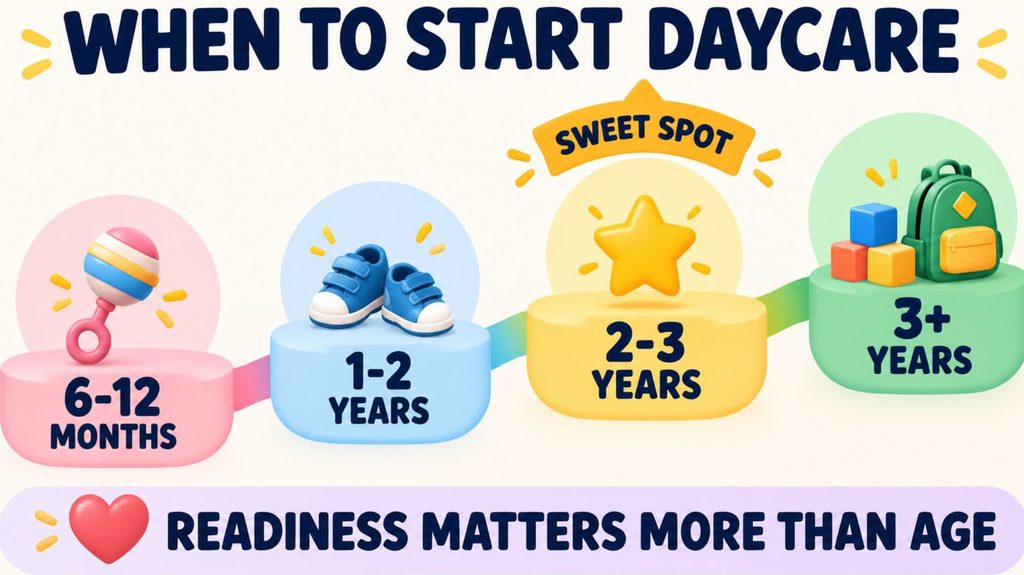
No, there’s no universal right age. Readiness depends on a child’s temperament, the quality of the daycare, and the family’s support system far more than their exact age in months. Most Indian families start somewhere between 6 months and 3 years, and each window asks something different of both the child and the centre caring for them.
That’s why, at Welmont, a child’s first weeks aren’t measured against a fixed checklist tied to age alone. Our Virtuous Circle encourages teachers to reflect on each child’s learning journey, understand their individual needs, and adapt their approach to support their growth, confidence, and happiness.
Age bands at a glance
Each stage of daycare asks something different of a child. Here’s what typically changes from 6 months through age 3:
| Age Band | What the Child Can Typically Do | What Daycare Should Offer | Parent Watch-Out |
| 6–12 months | Limited mobility, high need for comfort and routine | Low caregiver ratio, consistent feeding/nap schedule, sensory play | Separation anxiety and first-exposure illnesses are common |
| 12–24 months | Walking, early words, growing curiosity about peers | Structured but flexible half-day options, guided exploration | Watch for over-tiredness from too-long first days |
| 2–3 years | Cooperative play, basic self-care, longer attention span | Play-based group learning (music, movement, early phonics) | “Sweet spot” for most children to start structured group care |
| 3+ years | Ready for a formal daily routine and classroom structure | Transition to Playgroup/Nursery (NEP Foundational Stage) | Confirm centre-specific cutoff dates with admissions |
Starting at 6–12 months
Daycare from 6 months onward usually lines up with the end of maternity leave. At this age, infants need a low caregiver-to-child ratio, predictable feeding and sleep routines, and a comfort object from home, separation anxiety and infection risk are both at their highest.
A first week at this stage usually looks less like a full day and more like a few short visits, building up gradually. It’s worth a quick check-in with your paediatrician before enrolling a child under 1, and reviewing a centre’s health and hygiene practices in detail, our daycare safety and hygiene FAQ covers exactly what to ask.
Starting at 12–24 months
Between 1 and 2 years, most toddlers handle the daycare transition more smoothly than younger infants, walking and early words make them more adaptable, and curiosity about other children starts to outweigh separation anxiety. Half-day or flexible slots work well here, letting a child build stamina toward a full day.
Starting at 2–3 years
By 2–2.5 years, most children are ready for structured, play-based group learning, often called the “sweet spot” for starting formal early education. It’s also where India’s National Education Policy (NEP) 2020 begins to apply: under the 5+3+3+4 structure, Nursery (Balvatika 1) entry typically starts at a minimum age of 3, making the 2–3-year daycare year a natural bridge into formal schooling.
At this stage, activities like MusicWelTunes and LinguisticsWordWay (early phonics) build the listening and language habits that carry straight into Playgroup and Nursery, if you’re weighing which of those comes next, our Playgroup vs Nursery vs Junior KG guide breaks down the difference.
Signs your child may be ready for daycare, and signs to wait
Watch the child, not just the calendar. A few weeks’ difference rarely matters as much as these signals:
Signs of readiness:
- Sleeping and eating on a reasonably steady rhythm
- Showing curiosity about other children, not just caregivers
- Tolerating brief separations (a few minutes) without prolonged distress
Signs to wait a little longer:
- Frequent illness right now, on top of first-exposure risk
- Very high separation distress that hasn’t eased with short practice runs
- A major family transition happening at the same time (a move, a new sibling)
Is daycare bad for toddlers? What does the evidence actually say?
It’s natural to worry about leaving your toddler at daycare. Will they feel safe? Will they miss you? Research offers some reassurance: what matters most is the quality of care they receive.
A long-term study that followed over 1,300 children found that warm, responsive caregivers and a supportive environment were linked to better learning outcomes as children grew up. It also found that very long hours in childcare during the early years were associated with slightly more behavioural difficulties.
So, daycare isn’t something parents need to feel guilty about. What matters is finding a place where your child feels comfortable, receives individual attention, and is cared for with patience. At Welmont, the Happiness Quotient reflects the importance of a child’s happiness and emotional well-being.
How can play boost my child’s learning in the daycare years?

Play isn’t a break from learning at this age, it is the learning. Through movement, music, stories and sensory exploration, toddlers build language, motor skills and emotional regulation faster than through any worksheet-based approach.
At Welmont, this shows up by name: Dance WigglyWay for gross motor skills and confidence, MusicWelTunes for rhythm and early language, LinguisticsWordWay for phonics, WellnessWellWay for healthy daily habits, and the Once Upon A Time circle for storytelling and listening. This is also the thinking behind our broader Metamorphosis philosophy: the brain develops in response to its environment, and a genuinely play-based environment is doing more work than it looks like from the outside.
How do I prepare my toddler for daycare in the weeks before?
Start small: visit the centre together before the first full day, shorten the first week’s hours gradually, and keep home routines, nap, mealtimes, as consistent as possible during the transition. A phased start does more for easing separation anxiety than almost anything else.
5 steps to prepare your toddler for daycare:
- Visit the centre together at least once before the first full day
- Start with 1–2 short hours, with a parent nearby if the centre allows it
- Send a familiar comfort object, a blanket or small toy, from home
- Keep nap and mealtime routines consistent at home during the transition week
- Expect, and don’t panic over, a few early colds, it’s common first-exposure immunity building, not a sign something’s wrong
For a fuller week-by-week walkthrough, see our guide on preparing a toddler for preschool, which covers the same groundwork for the step after daycare.
Daycare, grandparents, or a nanny, how do Indian families decide?
All three can work well; the honest comparison is about consistency and stimulation, not which option is “better” in principle. Joint families with grandparents at home often delay daycare, and that’s a valid choice, not a worse one. Nuclear families without that support often need it earlier, and that’s valid too.
A nanny or grandparent gives one-on-one attention a daycare group can’t fully match. A quality daycare offers structured peer learning and a trained curriculum that a home setting usually can’t replicate on its own. Many Indian families land on a hybrid in the first few weeks, daycare for structured interaction and curriculum, with a grandparent or nanny covering the rest of the day while the child adjusts.
How does daycare lead into preschool at Welmont?
Daycare and Playgroup aren’t separate systems at Welmont, the same observation-based approach and Virtuous Circle reviews carry a child from daycare into Playgroup, Nursery and beyond, so the transition is a continuation, not a restart.
If you’re mapping out the years ahead, our post on the right age to start preschool picks up exactly where this one leaves off.
The takeaway
There’s no single calendar date that makes daycare “right.” Readiness, quality of care, and a gradual start matter far more than a specific age, whether your child is 6 months or 3 years old. The questions worth asking are the same at every stage: is the caregiver-to-child ratio right, is the day genuinely play-based, and does the centre see your child as an individual rather than a batch? Look for a place where your child feels safe, supported, and free to grow at their own pace.
Curious what that looks like in person? Book a centre visit or speak with our admissions team, or browse parent resources for more on settling a toddler in.
FAQs
Yes, many centres accept infants from 6 months, typically once maternity leave ends, provided the centre offers a low caregiver-to-child ratio and consistent routines.
No. Many toddlers adapt well around 12–18 months, often more smoothly than younger infants, as mobility and early communication make the transition easier.
Research doesn’t support that, the quality of care matters far more than the age a child starts. A warm, play-based daycare experience between 2 and 3 is linked to positive, not negative, outcomes.
Start shorter, 1–2 hours for the first few days, and build up gradually. Most research associates very long weekly hours (30+), not daycare itself, with added behavioural friction.
Frequent minor colds in the first few months are common first-exposure immunity-building, not a sign the daycare is wrong for your child. Consult your paediatrician if illness is severe or doesn’t taper off after a few months, and see our daycare safety and hygiene FAQ for what a well-run centre should have in place.