Quick Answer: Most children are ready for preschool between 2.5 and 3 years old, with playgroups starting around age 2 and structured nursery programs beginning around age 3. However, individual developmental readiness, not just chronological age, is the more reliable signal for when a child should start.
- Playgroup: ages 2–3, sensory play and short separations
- Nursery: ages 3–4, structured play and early communication
- Kindergarten/LKG: age 4+, pre-academic concepts and social collaboration
- Readiness matters more than exact age
- Mid-year admission is possible if readiness signs appear later
The Preschool Question Every Parent Faces
One of the most common questions parents ask during the toddler years is: “How do I know if my child is ready for preschool?” The answer is rarely as simple as reaching a certain birthday. Some children are eager to explore new environments and interact with other children at two and a half, while others may benefit from a little more time at home before making that transition.
This decision often feels significant because the early years are a period of remarkable growth and development. During this stage, children rapidly build the foundations for language, social skills, emotional regulation, and learning habits that will support them throughout their educational journey. It is natural for parents to wonder whether starting preschool now will help their child thrive or whether waiting a few more months might be the better choice.
The reassuring news is that preschool readiness is not determined by age alone. Instead, it is usually reflected in a combination of developmental signs. A child who can communicate basic needs, follow simple instructions, show curiosity about other children, and gradually become comfortable spending short periods away from parents may be showing signs of readiness.
This guide explores the typical preschool age range and the key indicators that can help parents make an informed decision.
What’s the Right Age to Start Preschool?
Most children in India are ready to begin preschool between 2.5 and 3 years old, with playgroups accepting children as young as 2 and structured nursery programs typically beginning around age 3.
That’s the general answer. But it’s an average, not a rule. Some children settle in beautifully at 2 years and 3 months. Others do far better waiting until they’re closer to 3 and a half. Both are completely fine, the number is a starting reference, not a deadline.
Preschool Stages, Age by Age
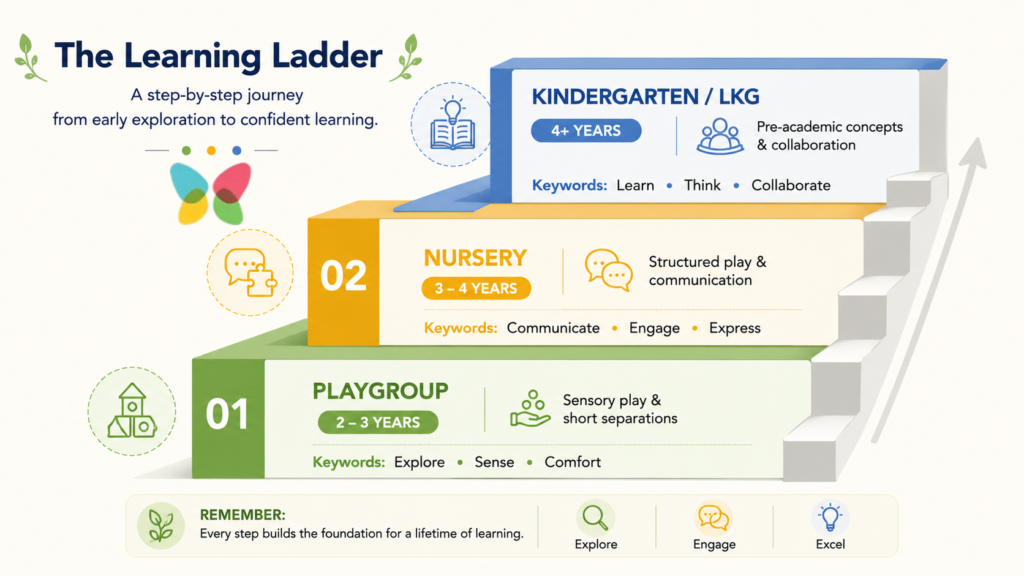
1. Playgroup (Ages 2–3)
This stage is built around sensory play, developing motor skills, and gently practicing short separations from parents. A typical morning looks unhurried, free play with textured materials, simple songs, a snack, and just enough routine to start feeling familiar without ever feeling rigid.
2. Nursery (Ages 3–4)
By this stage, children move into more structured play, basic daily routines, and the early stages of clear communication. Mornings usually include circle time, small group activities, and guided play that slowly introduces the rhythm of a “school day” without academic pressure.
3. Kindergarten / LKG (Ages 4+)
Here, pre-academic concepts enter the picture alongside deeper social collaboration. Children start working in small groups on shared tasks, and early literacy and numeracy ideas get introduced, always still wrapped in play, never as drilled lessons.
Forget the Birthday, Watch for These Signs Instead
A child’s readiness for preschool shows up through behavior, not age, and four signals matter far more than the number of candles on their last cake.
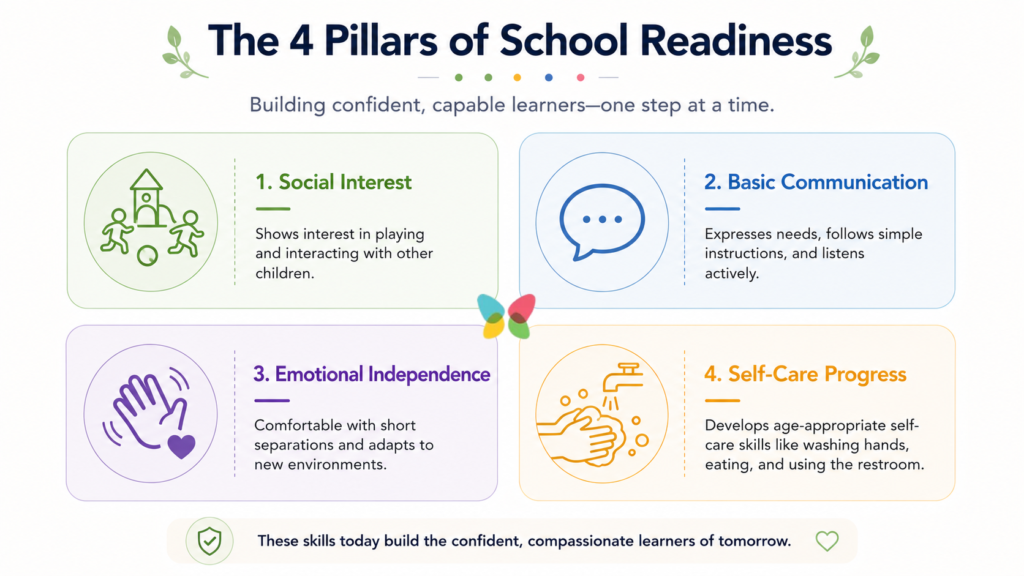
1. Social Interest
Does the child show curiosity about other children? Even just watching them closely, or attempting to play nearby, counts. Full sharing and cooperative play usually come later, early interest is enough of a start.
2. Basic Communication
Can the child express a simple need, hungry, tired, wants a toy, and understand a basic instruction like “please sit down” or “let’s wash hands”? This doesn’t require full sentences. Simple, clear signals are enough.
3. Emotional Independence
Can the child stay away from a parent or trusted adult for two to three hours without extreme, prolonged distress? A little crying at drop-off is normal and expected. The sign to look for is whether they settle within a reasonable window, not whether they cry at all.
4. Self-Care Progress
Independent eating, some progress with hand-washing, movement toward toilet training, none of this needs to be fully mastered. Progress, not perfection, is the actual marker.
A child doesn’t need all four of these fully checked off. Partial movement across most of them is usually a strong enough sign that preschool will support their growth rather than overwhelm it.
“Is 3 Too Late?” and Other Real Parent Worries
Somewhere between the WhatsApp parenting groups and the neighbor whose two-year-old is already “enrolled somewhere,” a quiet worry creeps in: is starting a little later putting a child behind?
It isn’t. Some children are genuinely more settled, more communicative, and more emotionally ready starting closer to age 3 than at 2 and a half. A slightly later start driven by actual readiness will almost always serve a child better than an earlier one driven by comparison. There is no lasting disadvantage in waiting a few extra months for a child who simply needed them.
What If Readiness Shows Up Mid-Year?
Development doesn’t check the academic calendar before it happens. A child might show every sign of readiness in August, well after most schools’ April admission cycles have closed for the year.
That’s not a lost year. Many preschools, including preschool options in Lalkothi and Gandhi Path West, Jaipur, do accommodate mid-year admissions once a child clearly shows the readiness signals above. It’s worth asking directly rather than assuming the window has closed, waiting an entire extra year isn’t usually necessary, and starting when a child is genuinely ready tends to matter more than starting exactly on schedule.
What Early Preschool Actually Builds (Beyond Academics)
The academic pieces, letters, numbers, shapes, are almost the smallest part of what preschool actually does in these years. The bigger work happening underneath is cognitive: memory, focus, early problem-solving. Social: sharing, turn-taking, reading another child’s mood. Emotional: naming feelings, managing small frustrations, trusting an adult who isn’t a parent. Physical: fine motor control from holding crayons and building blocks, gross motor growth from climbing and running.
None of this is really about being “ready for lessons.” It’s about a child feeling safe, curious, and genuinely happy while away from home for the first time, which, more than any curriculum, is what actually makes the transition into formal schooling smooth later on. For a closer look at how to evaluate a preschool once a child is ready, this guide on choosing the right preschool in Jaipur walks through what to look for during a visit.
How Welmont Supports a Child’s First Transition
Readiness looks different for every child, which is exactly why a fixed, one-size-fits-all pace rarely works well in those first months. Welmont’s classrooms follow a personalized rhythm, the Monthly Virtuous Circle approach, that gives each child room to settle in at their own speed inside a clear, supportive monthly structure, rather than forcing them to keep pace with a rigid syllabus from day one.
Foundational learning happens almost entirely through play, with a deliberately screen-free classroom, because a two-and-a-half-year-old builds far more real understanding from stacking blocks and pouring water than from a tablet. And alongside the early academic groundwork, there’s a steady, quiet thread of Sanskars woven into daily routines, the values of kindness, patience, and respect that shape a child just as much as any early literacy skill does.
All of this sits underneath what really matters in those first weeks: a child’s Happiness Quotient, whether they leave the classroom each day a little more confident, a little more curious, and genuinely glad to go back tomorrow. Families can explore how this plays out across each stage, Play Group, Nursery, Junior KG, Senior KG, and the Mother & Toddler programme, on Welmont’s programs page.Welmont runs preschool and daycare campuses across Jaipur, including Mansarovar, Vaishali Nagar, and C-Scheme, so parents can choose the centre closest to home.
A Quick Self-Check Before You Decide
Before settling on a start date, it helps to sit with four honest questions:
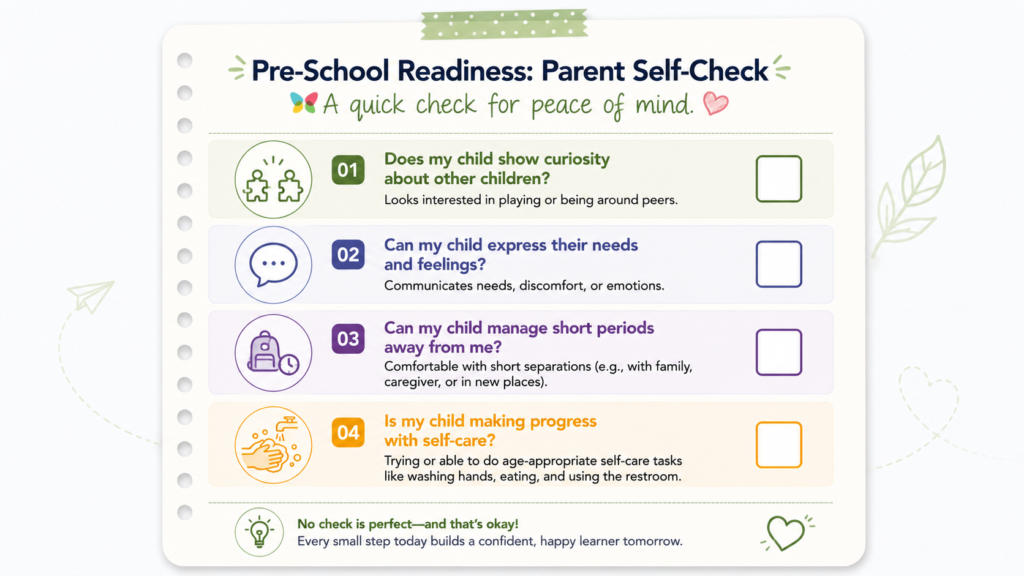
- Does my child show curiosity about other children, even just from a distance?
- Can my child tell me, in words or gestures, what they need?
- Has my child managed being away from me for a couple of hours without prolonged distress?
- Is my child making some progress with feeding themselves or basic hygiene, even if it’s not complete yet?
A confident “somewhat” on most of these is usually enough of a green light.
The Real Answer Isn’t a Number
The right age to start preschool was never really about turning a specific number. It’s about noticing a pattern most parents already sense, long before they can put it into words, a little more curiosity, a little more independence, a little more readiness to explore beyond the front door.
Spend this week watching for those four signs instead of counting down to a birthday. And when the pattern starts to feel clear, a visit tells you more than any checklist can, a chance to see a real classroom, meet the teachers, and let them gently assess readiness alongside you rather than leaving the guesswork to instinct alone.
Explore Welmont’s programs or get in touch to plan a visit whenever the time feels right.
Frequently Asked Questions
1. What is the right age to start preschool?
Most children are ready between 2.5 and 3 years old, with playgroups starting around age 2 and nursery programs beginning around age 3, though individual readiness matters more than the exact age.
2. How do I know if my child is ready for preschool?
Look for social interest in other children, basic communication of needs, the ability to be away from a trusted adult for 2–3 hours without extreme distress, and early progress with self-care like eating or hand-washing.
3. Is it too late to start preschool at 3?
Not at all. Many children are more settled and confident starting closer to age 3, and there’s no real disadvantage to a slightly later, more genuinely ready start.
4. Can my child join preschool mid-year?
Yes, many preschools accommodate mid-year admission once a child shows clear readiness signs, even if the academic session has already started.
5. What if my child isn’t ready for all the readiness signs yet?
That’s completely normal. A child doesn’t need to fully master every skill before starting; partial progress across most of the signs is usually a strong enough indicator that preschool will support their development rather than overwhelm it.