Quick Answer
Yes, children as young as 2 can enjoy Rajasthani folk art, once the activity is adapted for small hands. Tearing instead of cutting, stamps instead of fine brushwork, and household materials make Kathputli, Bandhani, Phad and more approachable at home or in a classroom, with no special skill or equipment needed.
- Eight activities, each adapted by age band
- Household materials only, nothing specialist
- A short story behind each art form
- A five-day Rajasthan week planner included
- Free printable activity cards to download
Introduction
At a Jaipur fair, a wooden puppet dances on strings while a toddler reaches out, utterly caught. Or maybe it is a Bandhani dupatta drying on a washing line, spotted with tiny tie-dyed dots a small finger cannot resist tracing. Many parents wonder if folk art is too advanced, too delicate, or too messy for a young child.
It is not, once the activity is resized. Research on early childhood development points to fine motor practice, repeated patterns and storytelling as strong, simple ways to support a growing brain. Rajasthan’s folk traditions happen to be full of exactly that: colour, pattern, repetition and story, all at once.
This guide walks through eight folk art activities adapted for ages 2 to 5, each one rebuilt for small hands, not shrunk down from an adult craft
Why does folk art work so well for under 5s?
Folk art gives young children colour, repeating patterns and a story to hold onto, three things that naturally hold a toddler’s attention while quietly building fine motor control and hand-eye coordination.
Colour and pattern are some of the first things a young child notices and sorts by, long before letters or numbers mean much. Repetition, a dot here, a stripe there, is satisfying to a small child in the same way stacking blocks is. Add a story, even a simple one, and the activity becomes something to talk about afterward, which helps build vocabulary.
There is a cultural layer too, and it is worth keeping light rather than leading with it. A child who tears paper into a Sanjhi pattern or dabs a potato stamp into a Bandhani dot is also getting an early, hands-on introduction to where they come from. That is a quiet bonus, not the main reason to try these activities.
Before you start: safety and set-up
A few minutes of set-up, non-toxic colours, supervision, and a simple mess plan, makes every activity below safe and low-stress.
- Colours and materials: use non-toxic, washable paints and dyes. Check labels, especially for anything that will touch a child’s hands or face.
- Supervision: stay close for anything small enough to be a choking hazard, such as beads, seeds or loose glitter. Swap these out for larger, safer alternatives with children under 3.
- Mess plan: old newspaper on the table, a simple apron or an old t-shirt, and a damp cloth within reach saves a lot of stress.
- Age bands: this guide uses two bands, 2 to 3 years and 4 to 5 years, since a 2-year-old’s hands and attention span need more adaptation than a 5-year-old’s.
8 Rajasthani folk art activities for preschoolers
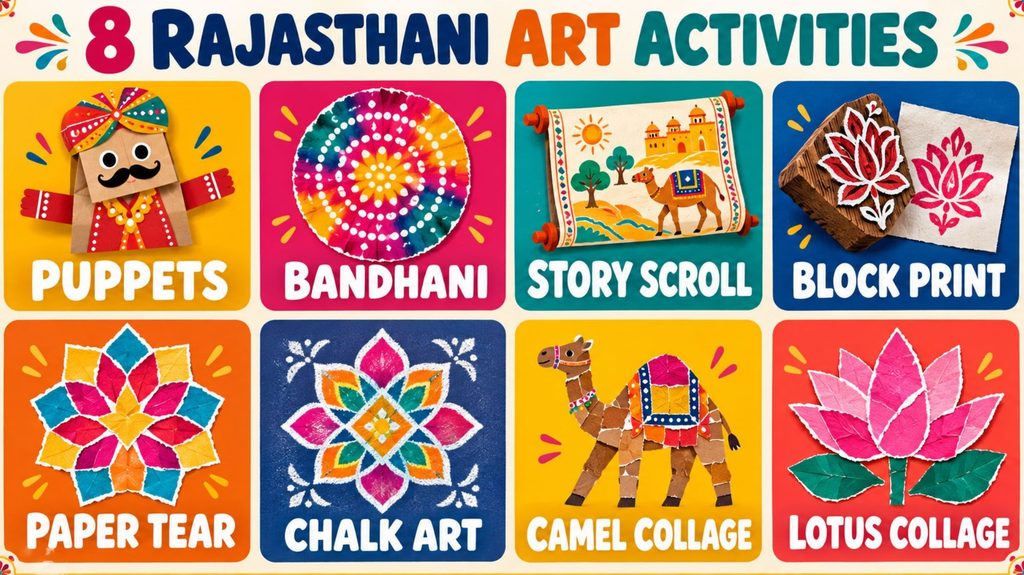
Each activity below includes the age band, the skills it builds, the materials needed, simple steps, an adaptation for younger hands, and a one-line story behind the art.
1. Kathputli-inspired puppets
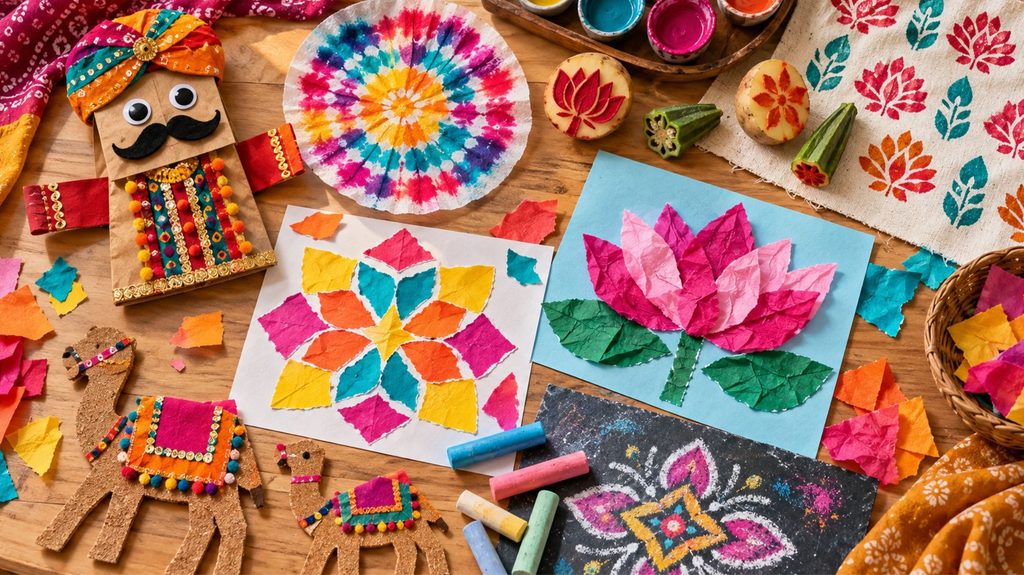
Age band: 2 to 5 years, with adaptation Skills: fine motor control, storytelling, early role play Materials: a popsicle stick or a small paper bag, scrap paper or fabric, crayons or stickers, glue
Steps
- Draw or stick on a simple face.
- Add scrap fabric or paper for clothing.
- Attach the face to a stick, or slide a hand inside a paper bag puppet.
- Put on a two-minute puppet show together.
Adaptation for 2 to 3 year olds: skip the stick entirely and use a paper bag puppet, which only needs a hand inside rather than fine finger control.
Story behind the art: Kathputli puppeteers have travelled Rajasthan for generations, telling stories of kings, heroes and everyday life through wooden puppets on strings.
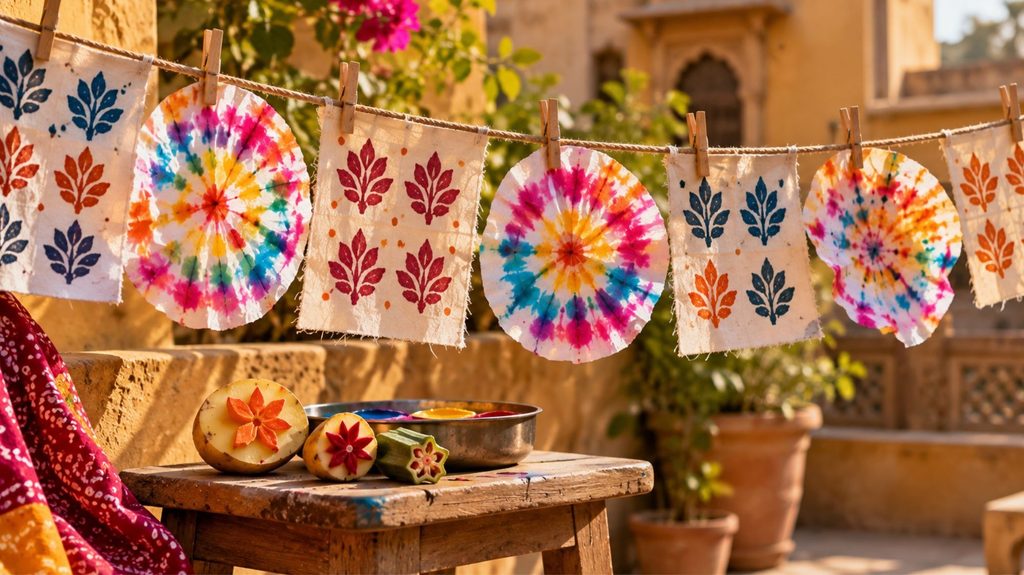
2. Bandhani dots
Age band: 2 to 5 years Skills: fine motor control, colour recognition, cause and effect Materials: a coffee filter or tissue paper, washable markers or diluted food colour, a small cup of water
Steps
- Let the child dot colour onto the flat filter or tissue paper using markers.
- Fold the paper gently, or simply dip one corner into water.
- Watch the colours bleed and spread into a tie-dye pattern.
- Unfold and let it dry flat.
Adaptation for 2 to 3 year olds: no tying needed, the dotting and water-dipping alone recreate the look, which keeps the activity entirely within a young child’s ability.
Story behind the art: Bandhani is a centuries-old tie-dye tradition from Rajasthan and Gujarat, where fabric is tied into tiny knots before dyeing to create these dotted patterns.
3. Phad story scroll
Age band: 3 to 5 years Skills: storytelling, sequencing, gross and fine motor control Materials: a long roll of paper (taped-together sheets work well), finger paints
Steps
- Roll out the paper on the floor or a long table.
- Ask the child to finger-paint a simple scene at one end: a house, a tree, a camel.
- Move along the scroll, adding a new scene for what happens next.
- Once dry, unroll the scroll and tell the story from start to finish.
Adaptation for 2 to 3 year olds: keep it to two or three scenes rather than a long sequence, and let an adult narrate while the child paints.
Story behind the art: Phad paintings are long scroll paintings from Rajasthan, traditionally used by travelling storytellers to narrate the deeds of local folk heroes, scene by scene.
4. Block printing with vegetable stamps
Age band: 3 to 5 years Skills: fine motor control, pattern recognition, cause and effect Materials: an okra or potato cut in half by an adult, washable paint, paper or plain fabric
Steps
- An adult cuts the vegetable in half, exposing its natural pattern.
- Dip the cut side into paint.
- Press firmly onto paper or fabric to leave a print.
- Repeat to build a pattern across the page.
Adaptation for 2 to 3 year olds: use a larger stamp, such as a halved potato, which is easier to grip and press than a smaller okra piece.
Story behind the art: hand block printing is a Rajasthani craft tradition, most famous in towns like Sanganer and Bagru, where carved wooden blocks are used to print intricate patterns onto fabric.
5. Sanjhi-style paper tearing and folding
Age band: 2 to 5 years, with adaptation Skills: fine motor control, hand strength, early pre-scissor skills Materials: coloured paper, safety scissors (for 4 to 5 year olds only)
Steps
- Fold a square of paper in half, then in half again.
- Tear or snip small shapes along the folded edges.
- Unfold to reveal a symmetrical pattern.
- Mount it against a contrasting background sheet.
Adaptation for 2 to 3 year olds: tearing instead of cutting removes the need for scissor control entirely, while still producing a similar patterned result.
Story behind the art: Sanjhi is a traditional Indian paper-cutting art, historically used to create intricate stencils for rangoli and devotional decoration.
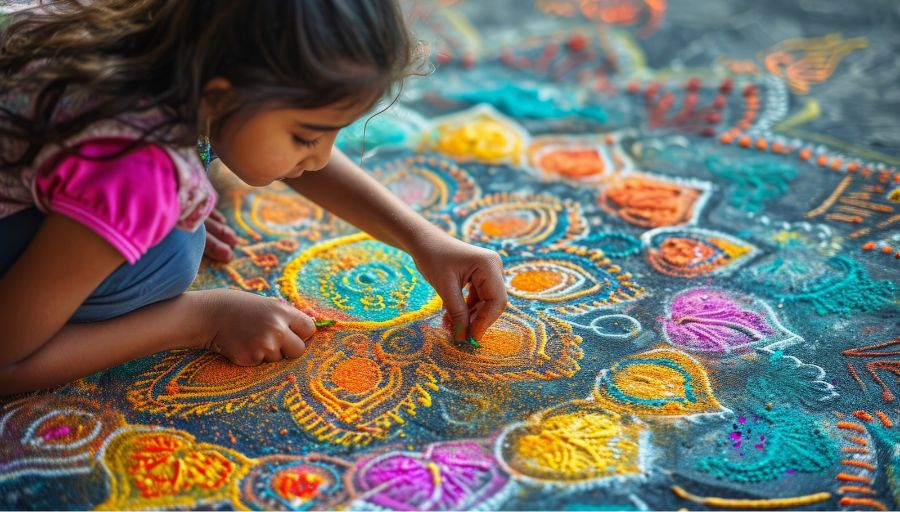
6. Mandana patterns
Age band: 2 to 5 years Skills: gross motor control, pattern repetition, outdoor sensory play Materials: chalk, a flat outdoor surface such as a wall or floor
Steps
- Draw a simple shape, a circle, a triangle, a dot grid.
- Let the child fill in or extend the pattern with their own chalk marks.
- Repeat the shape to build a border or a larger design.
- Step back and admire it together before it washes or wipes away.
Adaptation for 2 to 3 year olds: skip the structured shape entirely and let the child scribble freely within a chalk-drawn border.
Story behind the art: Mandana are traditional geometric wall and floor paintings made by women in rural Rajasthan, often drawn by hand or finger using natural chalk and red ochre, especially around festivals.
7. Camel and Thar desert collage
Age band: 2 to 5 years Skills: fine motor control, texture exploration, sensory play Materials: sandpaper or real sand, cloth scraps, glue, paper
Steps
- Draw or print a simple camel outline on paper.
- Let the child glue sand or sandpaper scraps onto the body for texture.
- Add cloth scraps for a saddle or blanket.
- Add a sand-textured background to complete the desert scene.
Adaptation for 2 to 3 year olds: pre-cut the camel shape and larger sand or cloth pieces so the child only needs to glue and press, not cut.
Story behind the art: the Thar desert and its camels are a familiar part of everyday life in rural Rajasthan, appearing often in folk art, fairs and festivals.
8. Pichwai-style lotus collage
Age band: 3 to 5 years Skills: fine motor control, colour and shape recognition Materials: coloured tissue paper, glue, a simple lotus outline on paper
Steps
- Tear tissue paper into small pieces.
- Scrunch each piece gently into a loose ball.
- Glue the scrunched pieces onto the lotus outline, petal by petal.
- Let it dry to reveal a textured, layered flower.
Adaptation for 2 to 3 year olds: use flat torn pieces instead of scrunched balls, which is easier for smaller fingers to manage.
Story behind the art: Pichwai paintings are traditional cloth paintings from Nathdwara in Rajasthan, often featuring lotus flowers and devotional scenes in rich detail.
A five-day Rajasthan week planner
A simple five-day plan lets a parent or teacher spread these activities across a week, pairing one art form with one story each day.
- Monday: Kathputli puppets and a mini puppet show
- Tuesday: Bandhani dots with coffee filters
- Wednesday: Phad story scroll, adding one new scene
- Thursday: Block printing or Mandana chalk patterns, depending on indoor or outdoor space
- Friday: Camel and Thar collage, finishing the week with a desert scene
This order moves from the simplest activities early in the week to ones that need a little more set-up, which keeps energy and interest steady.
Conclusion
Folk art does not need to wait until a child is older. It just needs to be resized: tearing instead of cutting, stamping instead of fine brushwork, a short story instead of a long one. Try one activity this week, see which one your child reaches for again, and build from there.
Try one activity this week, see which one your child reaches for again, and build from there.
Frequently Asked Questions
Most of these activities work from age 2 onward, once adapted, tearing instead of cutting, dotting instead of tying, scrunching instead of detailed folding. A few, like using safety scissors, are better saved for ages 4 to 5.
Bandhani dots and Kathputli paper-bag puppets tend to be the easiest starting points, since both rely on simple dotting or sliding a hand into a bag rather than precise cutting or folding.
Most of these activities use things already at home: paper, washable paint or markers, glue, scrap fabric, and a vegetable for stamping. Nothing specialist is required.
Keep it to one simple sentence, for example, that puppeteers in Rajasthan travel from place to place telling stories through puppets on strings. A 3-year-old does not need history, just enough of a story to make the activity feel like more than just craft.