Quick Answer: Montessori preschool lets a child choose activities and learn at their own pace through hands-on materials, while traditional preschool follows teacher-led lessons and a fixed daily schedule. Neither method is superior, the right fit depends on a child’s temperament, need for structure, and family priorities.
- Montessori = child-led, mixed-age classrooms, self-paced learning
- Traditional = teacher-led, same-age classrooms, fixed timetable
- Montessori suits independent, self-directed children
- Traditional suits children who thrive on routine and direct instruction
- Both prepare children for kindergarten, just through different paths
Introduction
Picture two three-year-olds on the same Tuesday morning.
In one classroom, a little girl walks past a shelf, picks up a wooden puzzle map of India, carries it to a small mat, and works on it alone for twenty minutes, no one interrupts her. In another classroom down the road, a little boy sits cross-legged with fifteen classmates, singing a rhyme about colours, waiting his turn to hold the red ball.
Both children are learning. Both are happy. Both will be perfectly fine adults one day. But the paths look nothing alike, and that difference is exactly what leaves parents standing in a school lobby, brochure in hand, quietly panicking.
Here’s a number worth sitting with: during these early years, a child’s brain forms more than a million new neural connections every second, a pace of growth that will never happen again in their life. That’s not a reason to overthink every decision. It’s simply why the environment a child spends their days in matters so much right now.
So, Montessori or traditional preschool? At Welmont, the honest answer starts not with a school’s philosophy, but with a child’s Happiness Quotient, the simple, powerful idea that a child who feels safe, curious, and genuinely engaged will absorb more than one who is only following instructions. Keep that thought close. It’ll matter by the end of this.
What Is Montessori Preschool, Really?
Montessori preschool is a child-led approach where children choose their own activities from a prepared set of materials and work at their own pace, with the teacher acting as a guide rather than an instructor.
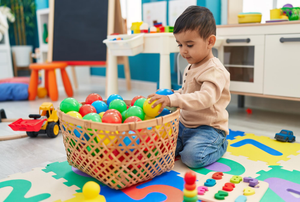
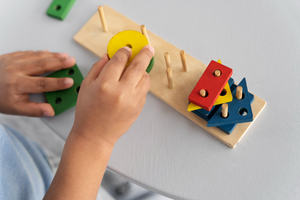
Walk into a well-run Montessori room and the first thing that hits you isn’t chaos — it’s quiet. Children move calmly between shelves. A four-year-old is pouring rice from one jug to another, entirely absorbed. A five-year-old is teaching a three-year-old how to lace a button frame. Nobody told them to do that. They just did.
How a Montessori Classroom Actually Works
Ages mix, usually 3 to 6 in the same room. Materials are open on low shelves, and a child can walk over and choose. Work periods stretch uninterrupted, sometimes for an hour or more, because Montessori’s founder, Dr. Maria Montessori, believed that interrupting a focused child does more harm than letting them finish.
What “Child-Led” Doesn’t Mean
Here’s where most parents get it wrong: child-led does not mean unsupervised or unstructured. Every material on that shelf has a specific purpose, a specific sequence, and a specific place it returns to. A Montessori classroom isn’t a free-for-all, it’s freedom within very deliberate limits. The rules are just invisible to a visiting parent’s first glance.
What Is Traditional Preschool, Really?
Traditional preschool is a teacher-led approach where children follow a structured daily schedule of group lessons, worksheets, and activities designed around age-based milestones.
This is preschool the way most Indian parents remember it, or something close to it, circle time, a rhyme, a craft, a snack break, story time, more structured play. The teacher decides what happens and when. Every child in the room does roughly the same thing at roughly the same moment.
A Typical Day, Hour by Hour
Morning assembly and attendance. A themed lesson, colours this week, animals next. A worksheet or tracing activity. Snack and a supervised break. Group play or a craft project. A closing circle before pickup. Predictable, rhythmic, comforting in its sameness.
Where Traditional Preschool Shines
Some children genuinely bloom here. The ones who ask “what’s next?” five times a day. The ones who feel calmer because they know exactly what’s coming. Traditional preschool gives them that, consistently, every single morning.
Montessori vs. Traditional: Side by Side
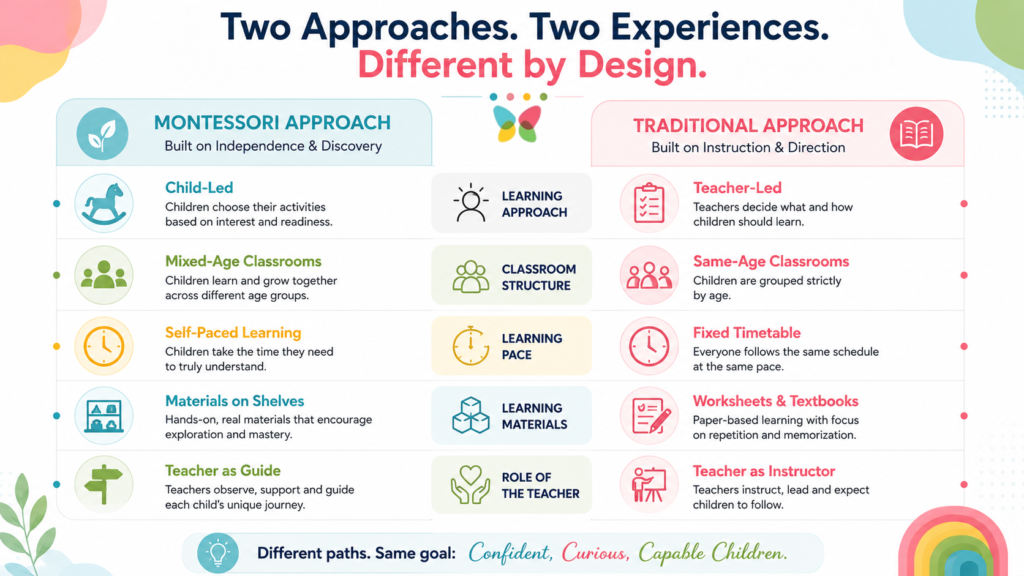
| What You’re Comparing | Montessori Preschool | Traditional Preschool |
| Who Leads the Day | Child chooses activities and learning experiences | Teacher sets the daily schedule and activities |
| Classroom Age Mix | Mixed-age classrooms, typically ages 3 to 6 years | Children grouped with peers of the same age |
| Pace of Learning | Self-paced, based on each child’s interests and readiness | Fixed pace with whole-class instruction |
| Teacher’s Role | Guide, facilitator, and observer | Instructor and director of classroom activities |
| How Progress Is Tracked | Continuous observation and individualized assessments | Worksheets, milestones, and periodic assessments or tests |
| Best Fit For | Independent, curious, and focused children who enjoy self-directed learning | Children who thrive on routine, structure, and group activities |
| Kindergarten Readiness | Developed through hands-on learning materials and practical experiences | Developed through direct instruction and structured academic preparation |
Which One Fits Your Child’s Nature?
Forget the philosophy debate for a second. Think about your own child at home, on an ordinary Sunday afternoon.
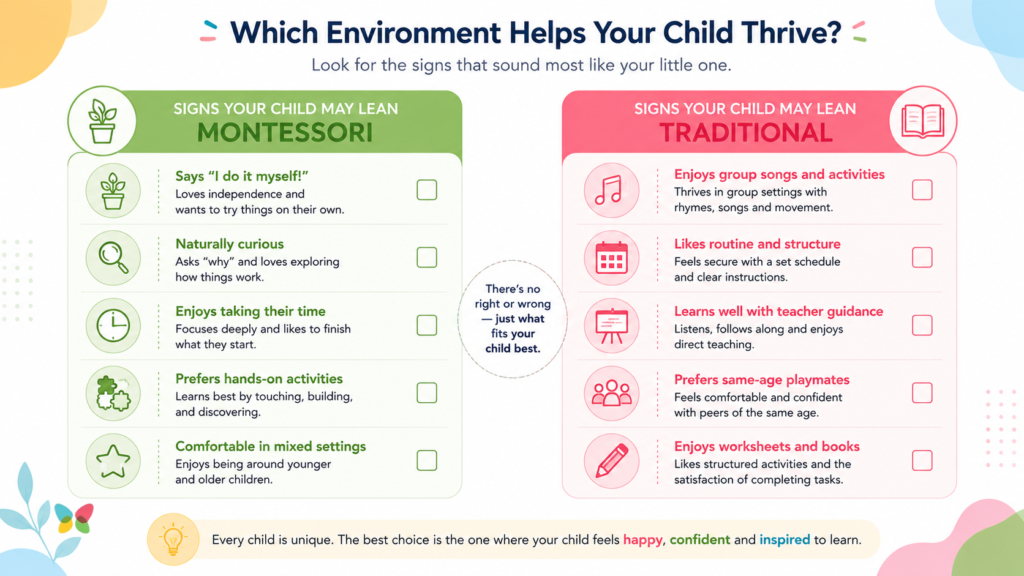
Signs Your Child May Lean Montessori
- Gets deeply absorbed in one toy or task and hates being pulled away mid-activity
- Says “I do it myself!” even when it takes three times longer
- Plays comfortably with both older and younger cousins
- Gets bored fast with repetition but focuses hard on things they chose themselves
- Prefers exploring quietly over big group games
Signs Your Child May Lean Traditional
- Feels most settled with a predictable routine
- Enjoys group songs, group games, and doing things “together”
- Looks to an adult for the next step rather than deciding independently
- Responds well to clear instructions and gentle direction
- Gets a little lost or overwhelmed with too many choices at once
When It’s Genuinely a Toss-Up
Most toddlers, if we’re honest. A two-year-old’s personality is still forming, and either environment, run well, with warm teachers, can help it form beautifully. If your child doesn’t fit neatly into either list above, that’s not a failure to diagnose. That’s just what being two years old looks like.
Montessori vs. Daycare: Clearing Up a Common Mix-Up
Plenty of parents ask this, quietly: Isn’t Montessori just an expensive daycare with nicer toys?
Fair question. The honest answer is no. Daycare, at its core, is about care and supervision, keeping a child safe, fed, and looked after while parents work. Montessori is an educational method first, built around a specific theory of how young children learn, with trained teachers and purpose-designed materials. Good daycare can absolutely include rich learning. But its primary job is custodial. Montessori’s primary job is developmental.
How Welmont Brings the Best of Both Into One Room
Here’s the part most comparison articles skip: for a lot of children, the real answer isn’t “pick a side.” It’s finding a place that borrows the best instincts of both.
That’s the thinking behind Welmont’s Monthly Virtuous Circle approach, a rhythm that gives each child the freedom to progress at their own pace, the way Montessori does, inside a structured monthly framework that traditional preschools do well. A child isn’t rushed to keep up with the room, but they’re also not left to wander without a clear developmental thread guiding the month.
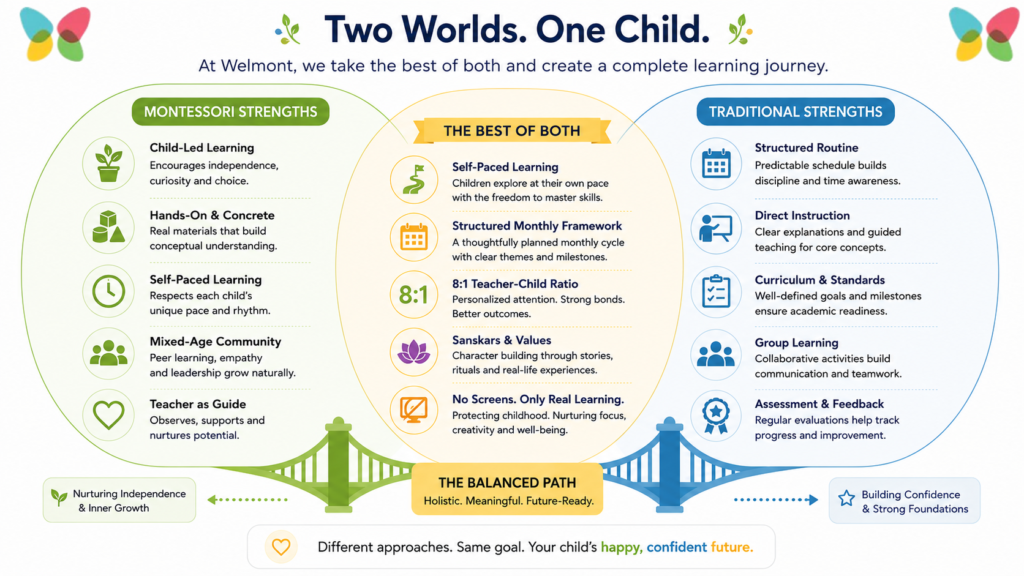
Learning at Welmont happens almost entirely through play-based, hands-on methods, because a three-year-old doesn’t build number sense from a worksheet, they build it from stacking blocks and pouring water and counting real things with real hands. And running underneath all of it is a quiet but deliberate focus on Sanskars, the core values of respect, kindness, and gratitude that neither pure Montessori nor pure traditional models explicitly teach, but that shape who a child becomes just as much as any academic milestone does.
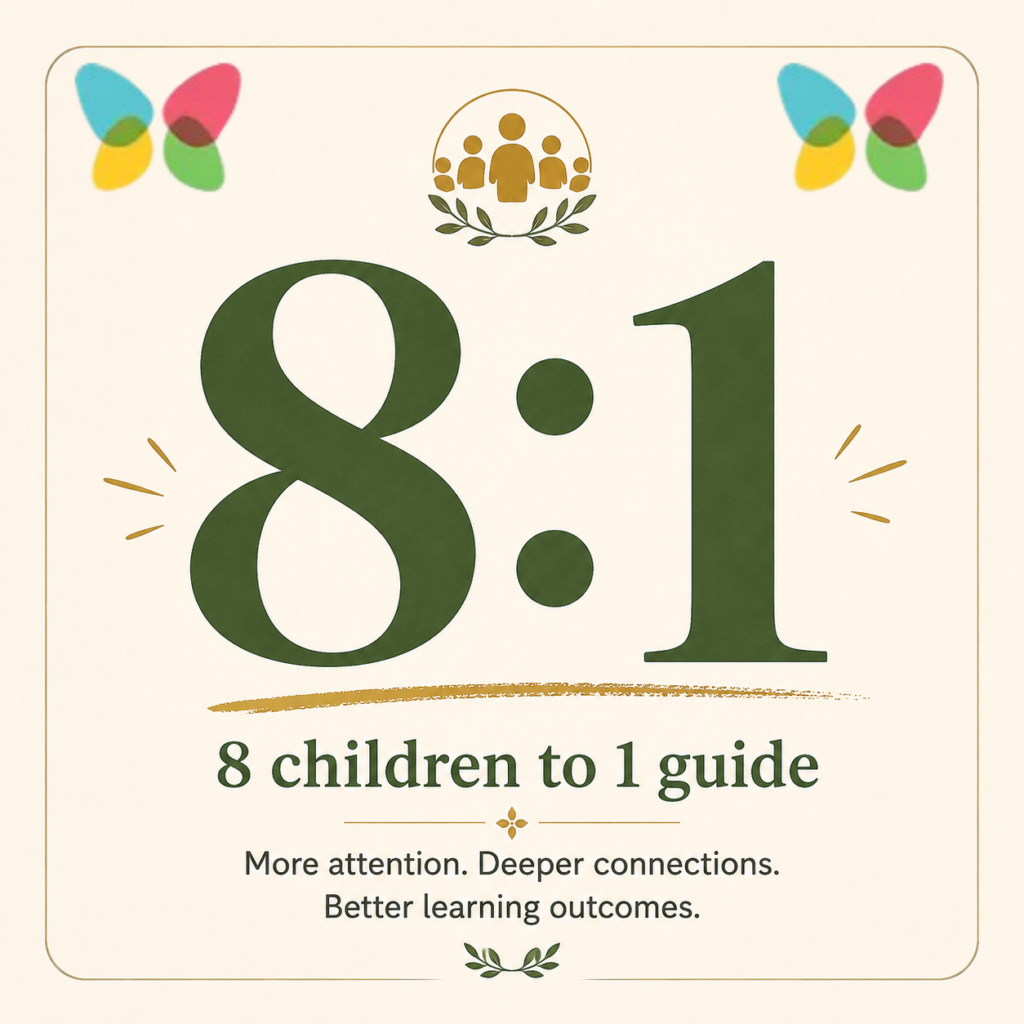
A few practical choices reflect this philosophy directly: classrooms run on an 8:1 child-to-teacher ratio, well ahead of standard recommendations, so no child gets lost in a crowd. And screens stay out of the picture entirely, because at this age, a real block in a real hand teaches more than a tablet ever will.
Whether your child is just starting out in Play Group, moving into Nursery, or preparing for Junior KG or Senior KG, this same principle holds: structure enough to feel safe, freedom enough to feel like themselves. Families needing full-day support will find the same philosophy woven into Welmont’s Daycare programme, and for the very youngest learners, the Mother & Toddler programme offers a gentle first step into this world alongside a parent.
So, Which Should You Choose?
Not “which method is objectively better”, that question has no real answer, and anyone who gives you a confident one is selling you something. The better question is: which room will your child walk into happily, on an ordinary Tuesday morning, three months from now?
You already know your child better than any framework does. Watch them this weekend, really watch, not with a curriculum in mind, just with curiosity. Notice what pulls their focus. Notice whether they seek company or solitude. That instinct will tell you more than this entire article has.
And when you’re ready to see it in person rather than read about it, come sit in a Welmont classroom for a morning. Watch your child, not the walls. It tends to make the decision a lot easier than it looks from the outside.
Ready to see it for yourself? Book a visit or start your admission inquiry at your nearest Welmont centre.
Frequently Asked Questions
1. Is Montessori better than traditional preschool?
Neither is universally better. Montessori suits independent, self-paced learners; traditional preschool suits children who do well with routine and direct guidance. The right choice depends on your child’s temperament, not on which method sounds more impressive.
2. What’s the real difference between Montessori and nursery school?
Montessori is child-led, with mixed-age classrooms and self-directed materials children choose themselves. Nursery or traditional preschool is teacher-led, with a fixed daily schedule and same-age peers moving through lessons together.
3. Is Montessori just a fancier daycare? No. Daycare is primarily about supervision and care while parents work. Montessori is a specific educational method built around trained teachers and purpose-designed materials, focused on development rather than supervision alone.
4. Will my child be ready for kindergarten either way?
Yes. Both approaches build genuine kindergarten readiness, Montessori through hands-on materials and self-paced mastery, traditional preschool through direct instruction and structured milestones. Neither path leaves a child behind when it’s implemented well.
5. How do I know which one fits my child?
Watch how your child plays at home. Do they seek independence and deep focus on one thing, or do they thrive on routine and group activity? That instinct, paired with an actual classroom visit, is usually the clearest signal you’ll get.