At a Glance
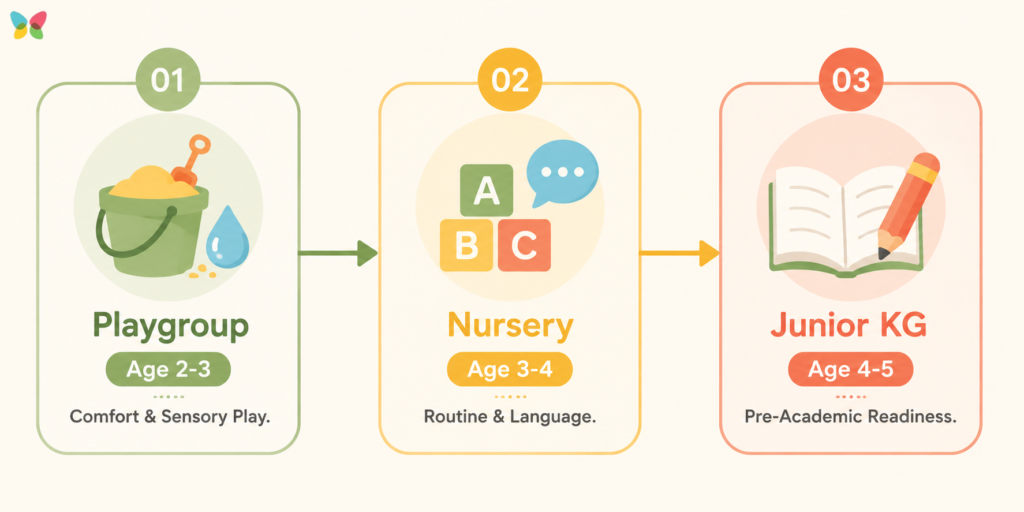
Playgroup, nursery, and junior KG are distinct stages of early childhood education, not interchangeable labels. Playgroup, roughly age 2 to 3, builds social comfort through sensory play. Nursery, roughly age 3 to 4, introduces routine and language. Junior KG, roughly age 4 to 5, develops pre reading and pre math readiness for formal school.
Quick answers parents are usually searching for:
- Playgroup, roughly age 2 to 3: unstructured play, sensory exploration, separation comfort
- Nursery, roughly age 3 to 4: semi structured routines, early language and number concepts
- Junior KG, roughly age 4 to 5: pre writing, phonics, counting, and school readiness habits
- Age is a useful guide, but a child’s emotional and social readiness matters more
- Skipping a stage or starting slightly later rarely puts a child behind
Why This Feels So Confusing (And It Genuinely Is)
Picture a parent, laptop open, admission season approaching, typing “playgroup vs nursery” into a search bar for the third time this week. One school website calls it a playgroup. Another calls the same age group pre nursery. A third skips straight to “preschool” as if that explains everything. By the fourth tab, even a fairly organized parent starts to wonder if they’re missing something obvious.
Here is the reassuring part. Nobody is missing anything. These terms genuinely are used inconsistently across Indian schools and cities, and there is no single standardized system everyone follows. The confusion is real, not a sign that something wasn’t researched properly.
Before untangling the labels themselves, it helps to understand why getting this staging right actually matters. By the time a child turns two, their brain has already reached roughly 80 percent of its adult weight. By age five, that number climbs to about 90 percent. During this narrow window, up to a million new neural connections are forming every single second. This is not a scary statistic. It is simply the reason why the experiences a child has in these early years carry so much weight, and why understanding which stage genuinely fits a child, rather than just what a school happens to call it, is worth ten minutes of real attention. For a deeper look at why this window matters so much, the earlier piece on the importance of early childhood education is a useful companion read.
What These Terms Actually Mean, in Plain Language
Before comparing the three stages properly, it helps to clear up the terminology fog in one sentence each.
Playgroup is the earliest, most informal stage, built almost entirely around play and comfort. Nursery is the next step up, where guided routines and early language begin to take shape. Junior KG, sometimes called LKG depending on the school, is where genuine pre academic readiness starts to build. Preschool, meanwhile, is really just an umbrella term covering all of these stages together, not a separate category sitting alongside them.
With that cleared up, here is what each stage actually looks like day to day.
Playgroup: The Gentle Beginning (Roughly Age 2 to 3)
The playgroup is not really about academics at all. It is about a toddler learning something far more fundamental: that the world does not end when a parent steps out of the room.
What a Playgroup Day Actually Looks Like
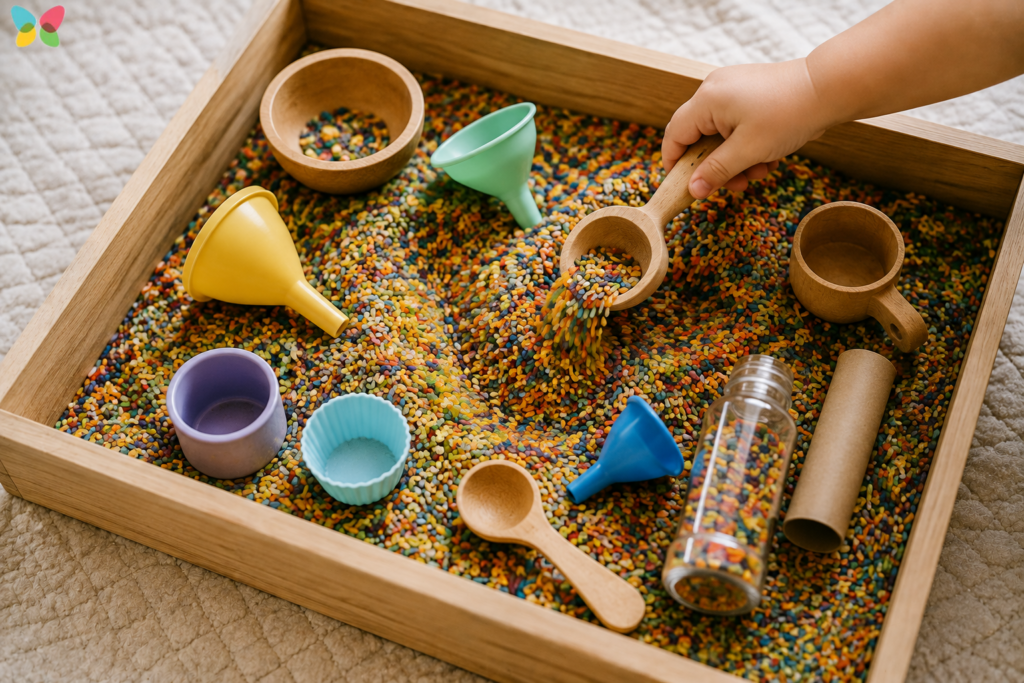
Walk into a well run playgroup classroom and there are no worksheets in sight. Instead there is sand, water, clay, music, and movement. There are rhymes sung in a circle, small hands exploring textures for the first time, and a teacher whose main job is simply becoming a trusted adult, someone a child feels safe being with even when a parent isn’t nearby. Sessions stay short, often just a couple of hours, because that is genuinely enough stamina for a child this age.
Is Playgroup Right for This Child?
Playgroup tends to suit children who are shy, who have had very little exposure to group settings, or who generally find change difficult. It gives them a gentle runway before nursery rather than a sudden leap into it.
That said, playgroups are not mandatory for every child. Plenty of toddlers skip straight to nursery at three and adjust just fine. Families exploring extended day options at this stage can also look at Welmont’s daycare program, which pairs the same warm, sensory rich environment with longer hours for working parents.
Nursery: Where Routine and Language Take Root (Roughly Age 3 to 4)
Nursery marks a real shift. This is where purely exploratory play starts gaining a learning intention behind it, even if it still looks a lot like play from the outside.
What Changes at This Stage
Vocabulary expands quickly during this year. Children begin recognizing colors, shapes, and early number concepts, not through formal instruction, but through songs, stories, sorting games, and everyday conversation. They also start learning what a routine actually feels like: what circle time means, when snack happens, how to wait for a turn without it feeling unbearable.
The Emotional Work Happening Underneath
There is something quieter happening alongside all of this too. Nursery age children are beginning to build a sense of self that exists separately from their parents. They are learning to express a need to an adult who isn’t mum or dad, to negotiate gently with other children, and to manage small frustrations without an immediate meltdown. None of this is taught directly. It simply happens, given the right environment and enough patient repetition. Welmont’s nursery program is built specifically around this stage of development, rather than treating it as a slightly shorter version of what comes next.
Junior KG: Preparing for the Structure of Formal School (Roughly Age 4 to 5)
Junior KG, often called LKG, is where genuine pre academic readiness and real classroom stamina start to build.
What Children Are Actually Learning
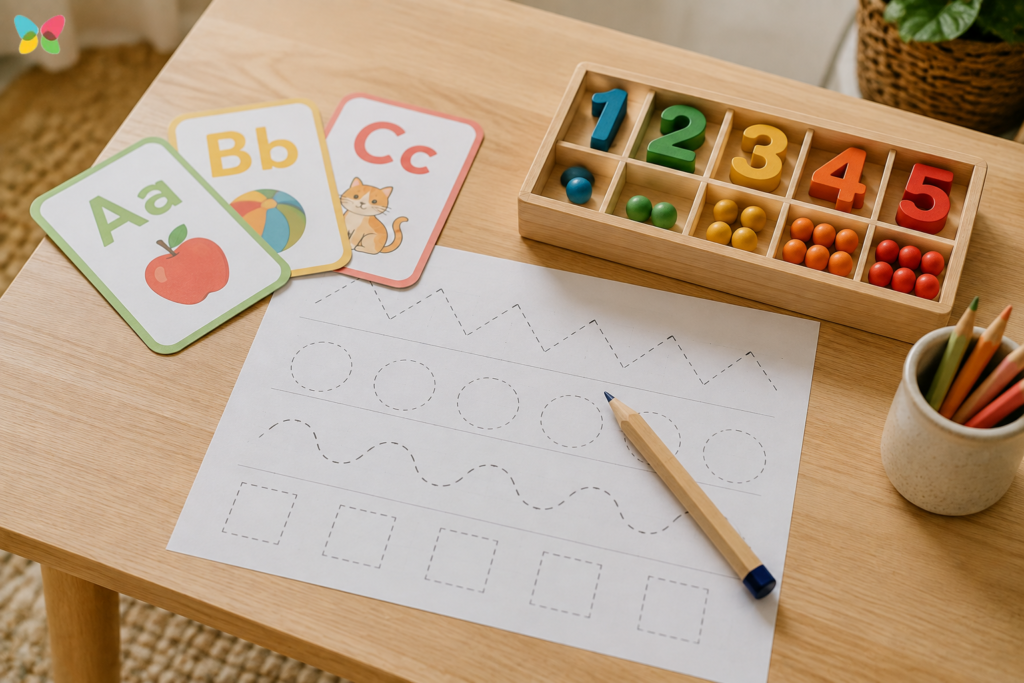
This is the stage where pre-writing begins, alongside phonetic sounds, basic counting, and following instructions that involve more than one step at a time. The curriculum still leans heavily on play, but the play now carries more deliberate structure behind it.
The Habits That Matter More Than the Curriculum
Here is something worth sitting with for a moment. The real outcome of a good junior KG year isn’t a child who can recite the alphabet perfectly. It is a child who can sit and actually focus for a stretch of time, follow a teacher’s instruction without needing it repeated three times, ask for help when something feels hard, manage their own belongings, and get along reasonably well with classmates. Those habits are what make Class 1 feel manageable instead of overwhelming, far more than any specific worksheet ever will. Welmont’s junior KG program is designed around exactly this shift, and families can see how it naturally leads into the senior KG stage as that final readiness builds toward primary school.
Age Versus Readiness: Which One Should Actually Decide?
This might be the single most useful question in this entire guide, and the honest answer is that readiness matters more than age, even though age remains the most reliable starting guide available.
Two children born in the same month can be in genuinely different developmental places. One might be confidently verbal and completely at ease in new environments. Another might still be deeply attached to a parent, with far less language, and would simply benefit from a few more months before starting.
The Five Signs Worth Watching For
A handful of signs, taken together, tend to matter more than a birth certificate ever will.
Emotional readiness shows up as the ability to manage brief separations without prolonged distress. Social readiness looks like genuine interest in other children, even before a toddler knows how to actually play alongside them. Communication readiness means expressing basic needs like hunger or discomfort, whether through words or gestures. Physical readiness includes attempting basic self care tasks, even imperfectly. And curiosity readiness simply means showing interest in exploring new places and meeting people outside the immediate family.
What If a Child Doesn’t Start “On Time”?
There is a common anxiety among urban Indian parents that starting a little later will somehow put a child behind. It is worth saying this plainly: research simply does not support that fear. A child who begins nursery at three years and two months, instead of two years and eight months, does not end up trailing behind their peers. What matters far more is the warmth of the environment and whether the child was genuinely ready when they walked in on day one. Starting before a child is ready tends to cause far more difficulty than waiting a few extra months ever would.
A Note for Multilingual Homes
Many families raise children surrounded by two or three languages at once, and it is a common worry that this might slow things down. It does not. Children growing up multilingual simply distribute their vocabulary across languages rather than developing more slowly overall. A good early years environment will welcome whatever language is spoken at home while gently building on it. A small, practical tip that helps enormously: let the teacher know exactly which languages are spoken at home before the settling in period begins. It helps them respond to a child far more sensitively in those first uncertain weeks.
How Welmont Approaches Each of These Stages
Every one of these stages deserves its own dedicated approach, not a shorter, slightly simplified version of the one that comes after it.
At Welmont, this shows up through the Monthly Virtuous Circle, a personalized pacing approach that lets each child move from simply observing to actively participating in their own time, rather than being pushed along a fixed calendar that assumes every child arrives ready on the same day.
Running underneath everything is what Welmont calls the Happiness Quotient, the belief that emotional security has to come before learning at every one of these stages, not just the youngest one. A child who feels genuinely safe becomes naturally curious, and curiosity is where real learning actually starts.
Alongside this, daily classroom routines gently nurture Sanskars, the everyday values of courtesy, gratitude, and respect that most Indian families are already building at home. A recent piece on teaching essential manners to kids explores this in more depth, and it pairs naturally with what happens in a Welmont classroom day to day. Combined with play based learning running consistently from Play Group through Nursery and into Junior and Senior KG, the transition between stages feels continuous rather than abrupt, which is exactly the point.
The Final Thought
Playgroup, nursery, and junior KG were never meant to be interchangeable labels on a school brochure. They are distinct developmental chapters, each doing quiet, important work that the next one builds directly on top of.
The right starting point for any child is the one that matches their actual readiness, not the age their neighbor’s child started, and certainly not whatever looks tidiest on an admission form. The clearest way to know which stage genuinely fits is to watch a child in the actual environment rather than deciding from a website alone.
Welmont welcomes families to visit, meet the teachers, and see a Play Group, Nursery, or Junior KG classroom in action before making any decision at all.
Frequently Asked Questions
1. What is the difference between a playgroup and nursery?
The playgroup, generally for ages 2 to 3, focuses on sensory play and helping a child feel comfortable away from parents, with very little structure. Nursery, generally for ages 3 to 4, introduces guided routines, early language, and basic number and letter concepts.
2. What is the right age for junior KG in India?
Junior KG typically suits children between 4 and 5 years old who can sit for longer stretches, follow multi step instructions, and are ready for early pre writing and pre reading activities, though exact cutoffs vary by school.
3. Does a child need to attend a playgroup before nursery?
No. Playgroups can ease the transition for shy children or those with limited peer exposure, but many children start directly at nursery and adjust perfectly well within a few weeks.
4. Does starting preschool a few months later put a child behind?
No credible evidence supports this. A child’s emotional readiness and the quality of the early learning environment matter far more than starting a few months earlier or later.
5. How do I know if my child is ready for the next stage?
Look for signs across five areas: managing brief separation calmly, showing interest in other children, communicating basic needs, attempting self care tasks independently, and curiosity about new environments.