
At a Glance
Preparing a toddler for preschool works best when it starts two to three weeks early, combining a school aligned daily routine, hands on practice with self help skills, a relaxed campus visit, and honest, reassuring conversations about what to expect, so the first day feels familiar instead of frightening.
Quick answers parents are usually searching for:
- Start adjusting sleep and meal timings 2 to 3 weeks before school begins
- Visit the classroom and meet teachers ahead of the first day
- Practice self help skills such as handwashing, shoes, snack time, and packing a bag
- Talk about preschool positively and avoid framing it as separation or loss
- Build a short, consistent goodbye ritual and repeat it every single morning
- Expect an adjustment window of a few days to a few weeks. That is completely normal
The Morning Every Parent Remembers
There is a particular kind of quiet that settles over a preschool gate on the first day. A small hand grips a parent’s fingers a little too tightly. A lunchbox is clutched like it holds something far more precious than a snack. Somewhere nearby, another child is laughing at nothing in particular, already halfway into their new world, while another is deciding whether today is the day they will cry.
Every parent standing at that gate is quietly asking the same question. Is my child actually ready for this?
Here is something worth knowing before that morning arrives. According to UNICEF’s research on early brain architecture, a young child’s brain forms roughly one million new neural connections every second in these earliest years. That is not a random statistic thrown in for effect. It means the toddler years, especially the window between two and a half and four, are exactly when a child’s brain is most sensitive to new environments, new faces, and yes, new kinds of separation.
That reframes what preschool preparation actually is. It is not just about lunchboxes and uniforms and getting the timing right. It is emotional groundwork, laid down during one of the most important developmental windows a child will ever have. For more on why this stage matters so much, this earlier piece on the importance of early childhood education is worth a read too.
The good news is that readiness is not a mystery, and it is not something that either magically appears or doesn’t. It can be built, gently and deliberately, in the weeks before day one.
What “Preschool Ready” Actually Means
Most parents assume readiness is about age. Turn three, start school. But age is only part of the picture, and a fairly small part at that.
Preschool readiness is really a cluster of small, observable signs that a child is prepared to spend a few hours away from home in a new environment. It shows up emotionally, physically, and socially, often at slightly different paces in each area, and that is completely normal too.
1. Emotionally, a ready child tends to show curiosity about new places rather than pure avoidance, and recovers from an upset within a few minutes rather than staying distressed for long.
2. Physically, readiness looks like attempting things independently, even imperfectly. Trying to put on shoes, even if they end up on the wrong feet. Attempting to wash hands, even if half the water ends up on the floor.
3. Socially, it often starts with simply noticing other children. A toddler does not need to be playing cooperatively with peers yet. Watching them with interest is often the very first stage of social readiness.
The table below breaks this down further.
| Area | Sign Your Toddler Is Ready | Still Developing (Also Normal) |
| Emotional | Curious about new places, recovers from upset within minutes | Needs more time to warm up to unfamiliar settings |
| Physical | Attempts shoes, washing hands, or snack time independently | Needs help but is willing to try |
| Social | Notices and watches other children with interest | Prefers parallel play or observing from a distance |
| Communication | Can express basic needs like hunger or tiredness in words or gestures | Relies mostly on gestures or crying to communicate needs |
| Routine | Can follow a simple two step instruction | Needs instructions repeated or simplified |
If a child falls somewhere in the “still developing” column, that is not a red flag. It simply means a little more groundwork will help.
Start the Clock Three Weeks Early, Not the Night Before
One of the most common mistakes parents make is treating preschool prep as something to sort out the weekend before school starts. In reality, the earlier the adjustment begins, the calmer that first week tends to be.
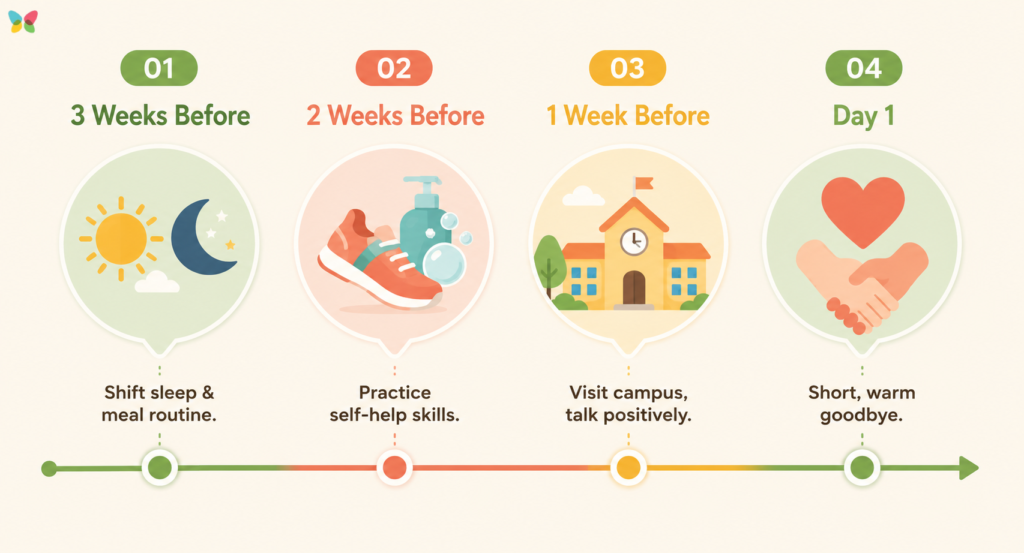
Rebuilding the Daily Rhythm
A toddler who wakes up at nine and naps whenever the day allows will struggle far more on day one than one whose body already expects a school day rhythm. About three weeks out, start gently shifting wake up time, meal times, nap timing, and bedtime toward what the school day will actually require.
This matters more than most parents realize. Overtired toddlers do not just struggle with tiredness. They struggle with emotional regulation, which means separation anxiety often gets blamed on “not being ready” when the real issue is simply exhaustion.
A Getting Ready Ritual That Doesn’t Feel Like a Drill
Instead of announcing the new routine like a rulebook, turn it into play. Set up a pretend classroom at home. Take turns acting out story time, singing songs, or even nap time, and let the child be the teacher for a bit. Children process big changes through play far more naturally than through explanation.
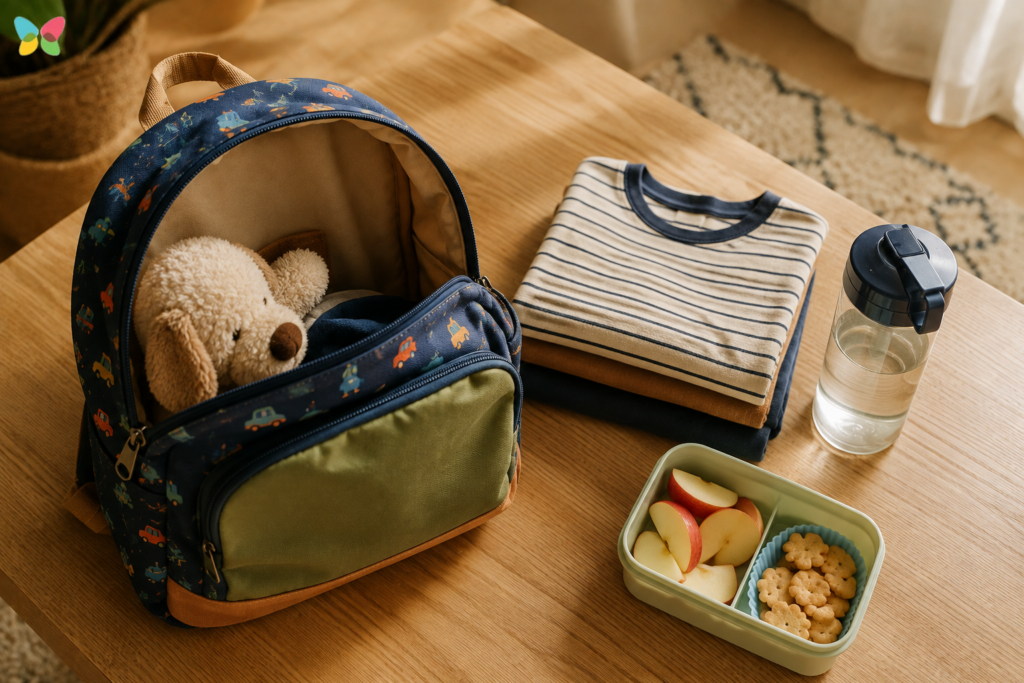
Packing a school bag together the night before, picking out clothes together, and eating breakfast together as a small ritual all help build a sense of predictability that carries a child through the actual morning with less friction.
Turning Self Help Skills Into a Game, Not a Test
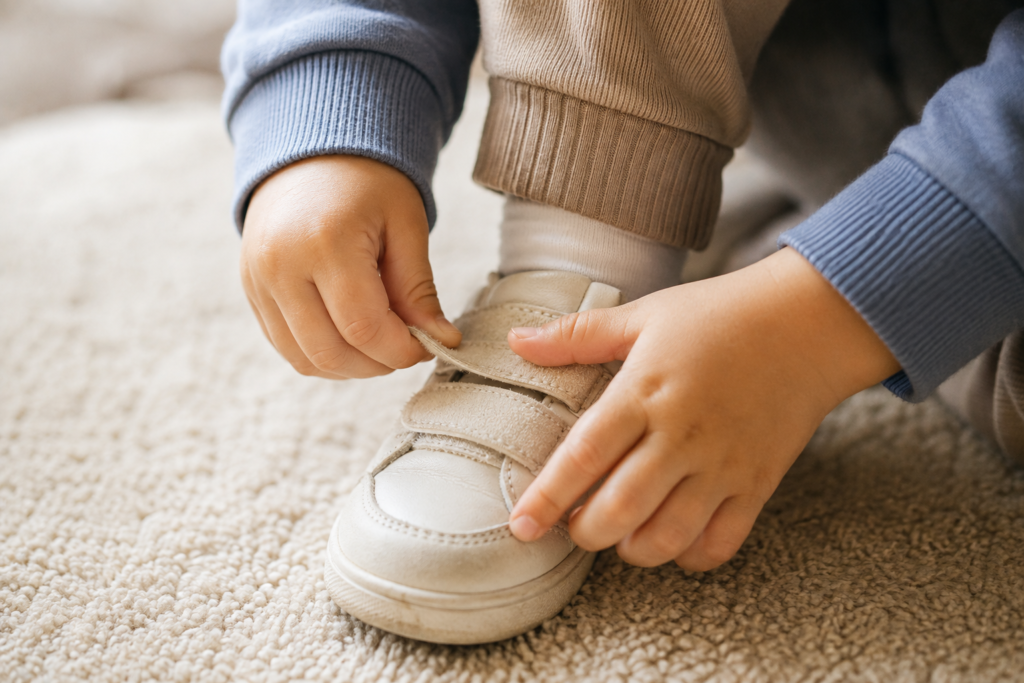
Preschool asks a lot of small, practical things from a toddler that home rarely requires. Putting on shoes without help. Washing hands independently. Managing a snack without assistance. Handling a bag or a coat.
None of these need to be perfected before day one. What matters is that the child has attempted them enough times to feel some confidence, rather than encountering them for the very first time in an unfamiliar classroom.
The trick is making practice playful rather than pressured. Turn shoe time into a race: “Let’s see how fast we can get these on today.” Celebrate the attempt, not just the success. A three year old who tries to zip their own jacket and gets halfway there has still built real confidence, even if a parent finishes the job.
What to Say (and What to Avoid Saying) About Preschool
Children pick up far more from tone than from actual words. The same piece of news can sound like an adventure or a threat depending entirely on how it is delivered.
Instead of saying, “You have to go to school now,” try something like, “You’re going to have so much fun meeting new friends and trying new games.” The information is the same. The emotional framing is completely different.
It also helps to talk, not just with the child, but with them. Ask gentle questions like “What do you think your classroom will look like?” or “What game do you think you’ll enjoy most?” These small conversations let a child process the idea gradually instead of encountering it all at once.
Sharing a parent’s own first day memories, even fuzzy or funny ones, can help too. Hearing that a parent also felt nervous once, and that everything turned out fine, tells a child something reassurance alone cannot.
At the same time, it helps to avoid over asking about fear. Repeatedly asking “Are you scared?” or “Will you cry?” often introduces anxiety a child wasn’t even feeling yet. Children tend to mirror the emotional state of the adults around them, so calm, steady framing usually works far better than repeated emotional check ins.
The Campus Visit That Actually Helps
If a pre enrollment visit is possible, it is one of the single most effective things a parent can do. Walking through the actual classroom, exploring the play area, and meeting the teacher by name before the first official day removes a huge amount of the unknown.
This is not about reassurance in the abstract sense. It is about reducing novelty. A child who has already seen the classroom, already knows what the teacher looks and sounds like, and already knows where the play corner is has one less unfamiliar thing to face on the actual first morning.
Families exploring a preschool for the first time can see what a typical day and classroom setup looks like across Welmont’s programs, from Play Group through Senior KG, before making any decisions.
Building the Goodbye Ritual, and Making Peace With Tears
The first drop off is often harder on the parent than the child, even though it rarely feels that way in the moment.
A good goodbye is short, warm, and predictable. A drawn out, emotional farewell tends to increase a child’s anxiety rather than ease it, simply because it signals to the child that something about this moment deserves extra worry. A simple, consistent ritual, a special phrase, a little handshake, a quick song, gives a child something familiar to hold onto every single morning.
Separation anxiety deserves an honest, direct answer here: most children settle within the first one to three weeks. Some adjust within days. Others take a little longer. Both are entirely within the normal range, and neither one means the school, the parent, or the child has gotten something wrong.
If a toddler has rarely spent time away from home, practicing short separations beforehand, with a grandparent, a trusted relative, or a close family friend, can help build the confidence that parents always come back, well before the first day of school ever arrives.
How Welmont Approaches This Transition
Every part of this preparation matters, but the environment a child steps into matters just as much.
At Welmont, this transition is treated as a gradual process rather than a single, high stakes event. The Monthly Virtuous Circle approach paces learning and settling in month by month, rather than expecting a child to adjust all at once. It allows teachers to personalize how quickly a child moves from observing to participating, based on how that individual child is actually responding, not a fixed timeline.
Central to this is what Welmont calls the Happiness Quotient: the idea that emotional security has to come before learning, not after it. A child who feels safe and happy in their environment naturally becomes curious, and curiosity is where real learning begins. Academic milestones follow far more easily once that emotional foundation is solid.
Alongside this, everyday classroom routines gently nurture Sanskars, the core values of courtesy, gratitude, and respect that most Indian families already build at home. The goal is for the classroom to feel like a natural extension of home, not a break from it. Combined with play-based learning at every stage, from Play Group and Nursery through Junior and Senior KG, children are given room to explore, build, and discover at their own pace rather than being pushed into rigid, early academics.
Bringing It All Together
Preparing a toddler for preschool was never really about eliminating every trace of nervousness. It is about making the unknown just a little smaller, one familiar routine, one practiced skill, one honest conversation at a time.
A rocky first week does not mean the school is wrong, the child is behind, or the parent has missed something important. It simply means a young child is doing exactly what young children do when big change arrives: adjusting, in their own time, at their own pace.
The best way to know if a preschool truly feels right is to walk through it together first. Families are always welcome to visit a Welmont campus, meet the teachers, and see the Monthly Virtuous Circle approach in action before making any decision. Those interested in taking the next step can explore the admission process here.
Frequently Asked Questions
1. How do I prepare my toddler for their first day of preschool?
Start two to three weeks early by shifting sleep and meal routines to match school timing, practicing basic self help skills, visiting the campus together, and talking about preschool in a warm, matter of fact way.
2. How long does it take for a toddler to adjust to preschool?
Most children settle within one to three weeks. Some adjust within days, others need a bit longer, and both are well within the normal range.
3. What are the signs a toddler is ready for preschool?
Readiness shows up as curiosity about new environments, attempts at self help tasks like washing hands or wearing shoes, and interest in other children, rather than a specific age.
4. How do I handle separation anxiety on the first day of preschool?
Keep goodbyes short, warm, and consistent, using the same brief ritual each morning. Long, emotional goodbyes tend to increase anxiety rather than ease it.
5. What should be in a preschool bag for the first day?
A comfortable bag the child helped choose, a labeled water bottle, a familiar comfort item if allowed, a spare change of clothes, and a favorite healthy snack.
