Quick Answer: Preschoolers learn math best through hands-on, playful activities, counting real objects, sorting by shape or color, and comparing sizes, rather than worksheets or memorization. These activities build number sense, pattern recognition, and early problem-solving skills that form the foundation for formal math learning later on.
- Count real objects (toys, snacks, stairs), not just recite numbers
- Sort and pattern with everyday items, buttons, blocks, leaves
- Compare sizes and quantities during daily routines
- Keep sessions short, playful, and pressure-free
- Let a child touch and move materials, not just watch
Introduction
A three-year-old stands proudly in the middle of the living room, reciting “one, two, three, four, five, six, seven” without a single stumble. A parent watching from the couch feels a small glow of pride, followed almost immediately by a quieter question. Is that actually math? Or is it just a very well-rehearsed song?
It’s a fair thing to wonder, because the two really are different skills. Reciting numbers in order is memory. Understanding what those numbers mean, that “three” is a quantity, that it’s more than “two” and less than “four,” is math. The gap between the two closes not through more recitation, but through hands, objects, and play.
Here’s the part worth holding onto. In these early years, a child’s brain forms more than a million new neural connections every single second, a pace of growth that will never repeat. Every time a toddler drops one block into a basket while saying “one,” then another while saying “two,” that physical repetition is quietly wiring the concept in, far more effectively than watching numbers scroll past on a screen ever could. This is a real look at how young children actually build number sense, by age, with concrete activities, and a look at how Welmont brings this into the classroom every single day.
Why Do Math Skills Matter Before Kindergarten?
Early math skills, counting, comparing, recognizing patterns, build the reasoning and problem-solving foundation a child relies on well beyond arithmetic. Long before formal schooling begins, these skills shape how a child sorts information, predicts what happens next, and makes sense of the physical world unfolding around them.
This isn’t about early academic pressure, and it was never meant to be. Number sense at this age doesn’t look like solving equations. It looks like noticing that one plate has more crackers than another, or that a tall glass and a short glass can still hold the same amount of juice. Those small noticings quietly build the same mental muscles a child will later use to sequence a story, follow a multi-step instruction, or understand ideas like “before” and “after.”
What Math Activities Are Right for Each Age?
Math activities should match a child’s developmental stage. Toddlers do best with sensory counting and simple sorting, three- and four-year-olds are ready for more structured number recognition, and children approaching kindergarten can start exploring early patterns and measurement concepts.
Ages 20 Months to 3 Years (Play Group Stage)
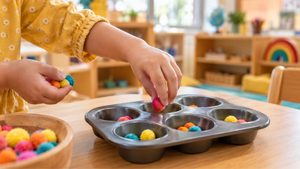
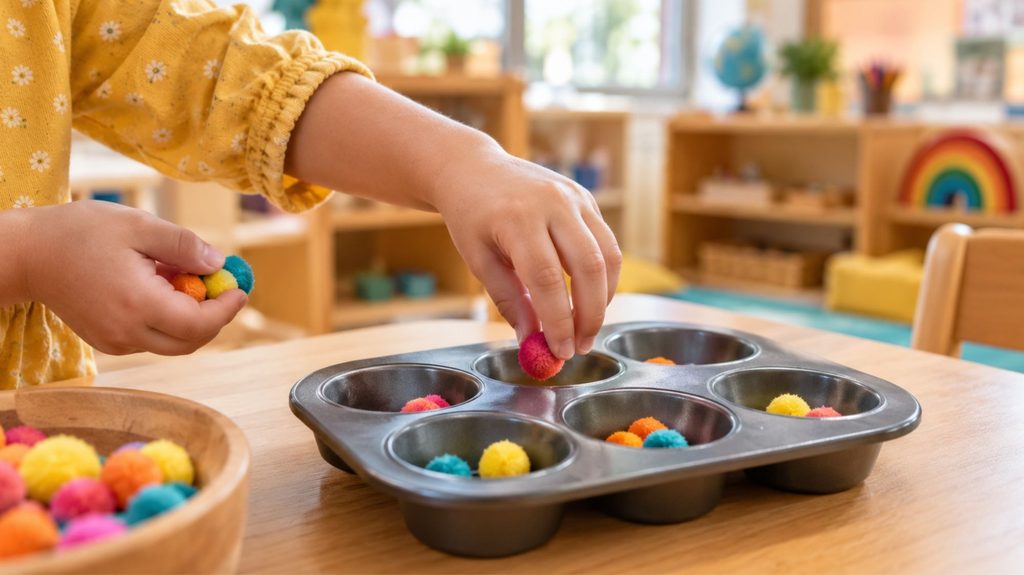
At this stage, math is almost entirely sensory. A muffin tray and a bowl of pom-poms becomes a full counting activity: one pom-pom dropped into each cup, counted aloud, over and over. Simple sorting by color, rhythmic counting songs, and repetitive games build the earliest sense that numbers exist and follow a pattern, long before a child could ever write one down. Families exploring this stage can find more detail on the Play Group programme.
Ages 3 to 4 Years (Nursery Stage)
Number recognition starts taking shape here, alongside one-to-one counting, which is the skill of touching each object exactly once while counting. It’s a surprisingly tricky coordination task at this age. Simple comparisons enter the picture too. “Which pile has more grapes?” becomes a genuinely engaging question rather than an abstract one. More on this stage is available on the Nursery programme page.
Ages 4 to 6 Years (Junior KG–Senior KG Stage)
By this point, children are ready for patterns, early addition and subtraction using real objects, and beginning measurement concepts like taller, shorter, heavier, and lighter. This is where math starts quietly connecting to everyday reasoning in a more visible way. Details on this stage can be found across the Junior KG and Senior KG programmes.
What Are the Best Counting Activities for Preschoolers?
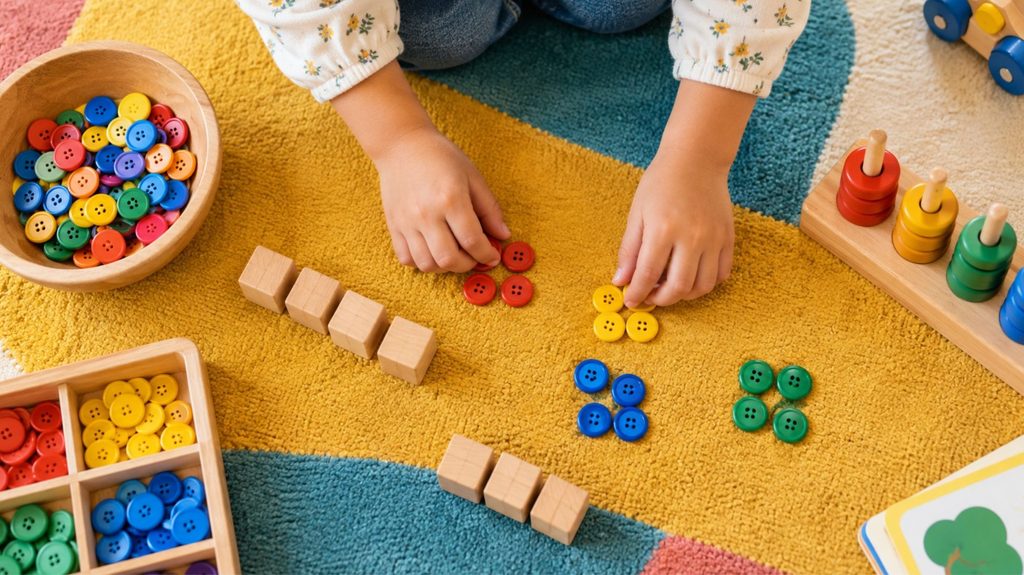
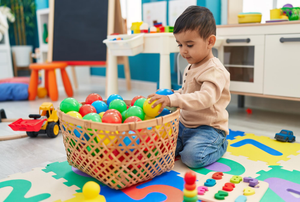
The most effective counting activities involve touching and moving real objects, like buttons, blocks, and snacks, while counting aloud, since physical repetition builds number sense far more reliably than reciting numbers without objects to anchor them.
A few that work particularly well:
- Count each step while walking up a staircase together
- Sort snack pieces into small counted groups before eating them
- Play a quick “how many claps” game during transition moments between activities
- Count toys out loud while placing them back into a basket at cleanup time
One small classroom moment illustrates this well. A hesitant three-year-old once refused to join a group counting circle at all, staying quiet at the edge of the group for days. Rather than pushing the point, the counting simply moved into snack time instead, counting out crackers one by one before eating them. Within a week, that same child was counting along enthusiastically, not because anything was forced, but because counting had quietly become part of something familiar and enjoyable rather than a lesson to perform.
How Do Preschoolers Learn Shapes and Patterns?
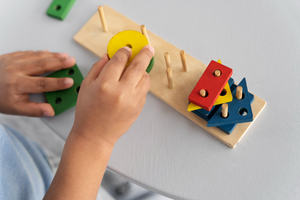
Children build shape and pattern recognition through hands-on sorting and sequencing, grouping similar shapes, continuing a bead pattern, or spotting shapes in everyday objects like windows or plates, well before they can name geometric terms formally.
A shape hunt around the house works well here. Circles show up on clocks, squares on tiles, triangles on a sandwich cut diagonally. Pattern-building with blocks (red, blue, red, blue, what comes next?) turns prediction into a game. Tracing shapes in a tray of sand or rice adds a tactile layer that helps the shape genuinely register, not just get glanced at.
What Are Simple Comparing and Measuring Activities for Young Children?
Comparing and measuring activities help children grasp concepts like “bigger,” “smaller,” “more,” and “less” through direct, physical comparison, whether that’s lining up objects by height, weighing items on a simple balance, or pouring water between containers of different sizes.
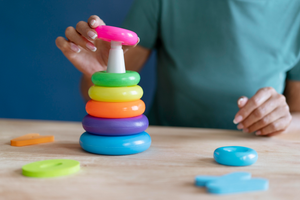
Sorting laundry by size before it’s folded turns a household chore into a comparison exercise. Comparing shadow lengths outside at different times of day adds a small dose of wonder to the concept. Stacking blocks from tallest to shortest is simple enough for a two-year-old and still genuinely useful for a five-year-old refining the same skill with more precision.
How Can Parents Build Math Skills at Home Without Worksheets?
Everyday routines already contain natural math moments. Counting stairs, setting the table with one plate per person, sorting laundry by color, or comparing fruit sizes at the market all build number sense without ever needing a formal lesson or printed worksheet.
A few to try starting this week:
- Count out plates and spoons together while setting the table
- Compare two fruits at the market and ask which one is bigger or heavier
- Sort toys into groups by color before putting them away
- Count claps, jumps, or steps during a quick game after dinner
None of these need preparation, materials, or a single worksheet. They just need a few extra seconds of noticing built into a routine that was already happening anyway.
How Does Welmont Approach Early Math Learning?
Welmont teaches math entirely through play-based, hands-on classroom activities, never worksheets or rote drilling, woven into concept-time blocks and daily routines so children build number sense the way they naturally learn best: through touch, repetition, and real objects.
This reflects the same principle running through the rest of a Welmont day. A child’s Happiness Quotient matters as much as any specific skill being taught, and a calm, unpressured child simply absorbs concepts more readily than one being drilled toward a target. Counting activities sometimes fold naturally into storytelling and community moments too, like distributing snack portions fairly among classmates during group time, quietly reinforcing both numeracy and the values of fairness and sharing that sit at the heart of Welmont’s approach to Sanskars.
Families curious to see this in action can explore the Nursery and Junior KG programme pages or learn more through Admissions.
Math Milestones and Activities at a Glance
| Age Range | Skill Milestone | Welmont Activity |
| 20 months–3 years (Play Group) | Sensory counting, simple sorting | Counting songs, color-sorting play |
| 3–4 years (Nursery) | Number recognition, one-to-one counting | Object-counting games, snack-time counting rituals |
| 4–6 years (Junior KG–Senior KG) | Patterns, early addition, measurement | Pattern-building blocks, water and sand measuring play |
A Simple Weekly Math Play Plan for Home
- Monday: Count something real, like stairs, snacks, or toys
- Tuesday: Sort an everyday item by color or size
- Wednesday: Build or continue a simple pattern together
- Thursday: Compare two things and talk about which is bigger or heavier
- Friday: Free play with blocks or shapes, no structure needed at all
The Song Was Never the Point
That confident recitation of “one to seven” in the living room was never really the finish line, and it was never something to feel behind about if it hadn’t happened yet either. It’s simply the first note in a much longer, genuinely playful process, one built from muffin trays, snack counting, and shadow comparisons far more than from any worksheet.
The goal was never early academic pressure. It’s steady, hands-on exposure that lets real confidence with numbers build slowly and naturally, the way it’s supposed to.
Curious to see play-based math learning happen in a real classroom? Book a school tour with Welmont and watch it unfold in person.
Frequently Asked Questions
1. What math skills should a 3-year-old have?
Most 3-year-olds can recognize a few numbers, count a small group of objects with some accuracy, and understand basic comparisons like “more” and “less,” though this varies naturally from child to child.
2. How do I teach my toddler to count without worksheets?
Use real, touchable objects such as snacks, toys, and stairs, and count them aloud together during everyday moments, since physical repetition builds number sense far more effectively than printed numbers alone.
3. What are good number activities for preschoolers?
Counting songs, sorting games, snack-time counting, and simple pattern-building with blocks are all effective, screen-free ways to build early number sense.
4. Is my child behind if they can’t count to 10 yet?
Not necessarily. Number sense develops at different paces, and what matters more at this age is steady, playful exposure rather than hitting a specific number by a specific age.
5. How does Welmont teach math to young children?
Welmont builds math learning entirely into play-based classroom activities and daily routines, using real objects and hands-on games rather than worksheets or rote memorization.